The Great Temple Circuit of Dravidian India
This is the most comprehensive South India temple tour available — a 14-day circuit of the greatest Dravidian sacred sites, from the ancient Pallava port of Mahabalipuram to the island sanctuary of Rameswaram, where India reaches toward Sri Lanka across the Palk Strait. Eleven destinations. Over three thousand years of temple-building tradition. One extraordinary journey.
South India's temples are not simply ancient monuments — they are living sacred spaces, functioning as they have for centuries, with daily rituals, processions, festivals, and the constant movement of devotees who have come on pilgrimage from across the subcontinent. The Dravidian style of temple architecture — characterised by its soaring, sculpture-encrusted gopurams (gateway towers), sacred tank (temple pond), and concentric enclosures — reached its peak expression in Tamil Nadu, and nowhere else on earth is this tradition so concentrated, so vivid, and so uninterrupted.
The tour begins at Tirumala — the world's most visited religious site — before moving through the UNESCO shore temples and rock-cut caves of Mahabalipuram, the silk-city shrines of Kanchipuram, the French colonial architecture of Pondicherry (with its Sri Aurobindo Ashram), the Nataraja Temple at Chidambaram (where Shiva performs his cosmic dance for eternity), the vast Brihadeeswara complex at Thanjavur (a UNESCO World Heritage masterpiece), the rock fort temple at Trichy, the living city that is the Meenakshi Amman Temple at Madurai, the sacred Ram Setu island of Rameswaram, and finally Kanyakumari at India's southernmost tip.
This is not a sightseeing circuit. It is a spiritual journey through the oldest living religious tradition on earth.
What makes this journey special
Your journey, unfolded
Welcome to South India! Your Discover India representative meets you at Chennai International Airport and transfers you to your hotel. The afternoon is free — explore the environs of your hotel, or take an evening walk to Marina Beach (13 km of golden sand along the Bay of Bengal, the world's second longest urban beach).
Full day in Chennai. The Kapaleeshwarar Temple in Mylapore — a magnificent Dravidian temple with a 37-metre gopuram, the finest in Chennai. Fort St George (1644) — the first British fortification in India, housing the Tamil Nadu Legislative Assembly and a museum of colonial-era artifacts. The Government Museum Complex — one of the finest collections of South Indian bronzes, Amaravati sculptures, and Chola-era art anywhere in the world. Evening: a Tamil Nadu classical music or Bharatanatyam performance at the Kalakshetra Foundation (advance booking required).
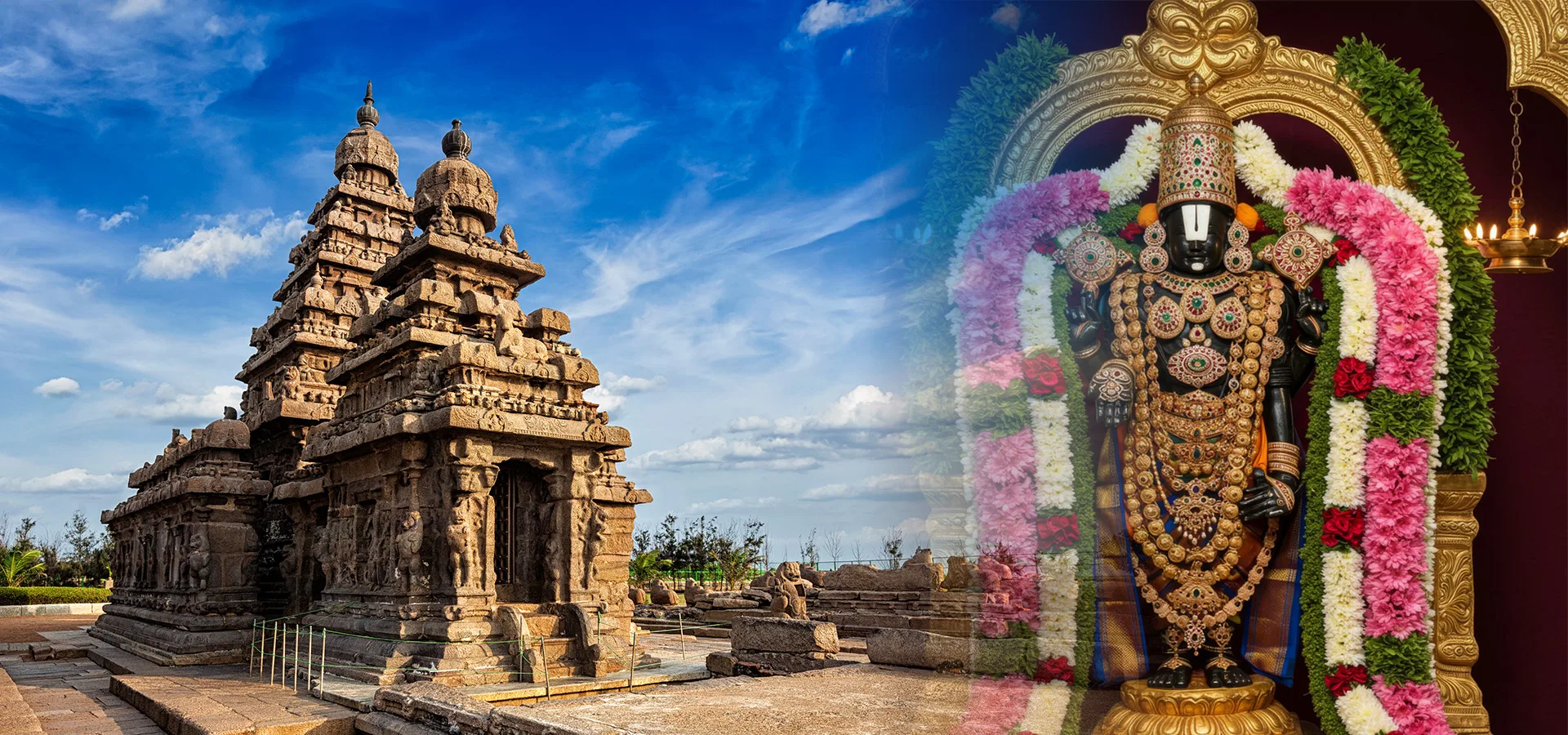
Drive south along the East Coast Road to Mahabalipuram (60 km, 1.5 hrs). The Shore Temple — 7th-century CE, earliest structural stone temple in South India, on the Bay of Bengal. The five Pancha Rathas — monolithic chariot temples carved from single granite outcrops. The Descent of the Ganges (Arjuna's Penance) — the world's largest bas-relief carving on two enormous boulders. Tiger Cave and Krishna's Butter Ball (a 250-tonne rock balanced on a slope for over 1,300 years). En route back, stop in Kanchipuram for the 8th-century Kailasanatha Temple — the finest early Pallava architecture in existence.
Drive to Kanchipuram (one of India's seven sacred Hindu cities) for a full morning of temple exploration. Ekambareswarar Temple (the Shiva lingam is a living mango tree said to be 3,000 years old — one of the Pancha Bhuta Stalas). Kamakshi Amman Temple — the most important Shakti temple in Tamil Nadu, one of the three great Shakti Peethas of the south. Varadharaja Perumal Temple (one of the 108 Vishnu Divya Desam temples; its 100-pillared mandapam is extraordinary). Visit a traditional Kanchipuram silk weaving establishment before driving to Tirupati.
Early morning: ascent to Tirumala Hills (853m) for darshan at the Venkateswara Temple — over 50,000 pilgrims arrive every day, yet the atmosphere of concentrated devotion is extraordinary. The golden gopurams, the sacred queue, and the brief but profound moment before the main deity are a spiritual experience unlike any other. After darshan, drive to Pondicherry (210 km, ~4 hrs). The former French territory is a remarkable cultural anomaly — French colonial villas, baguette bakeries, and an Aurobindo Ashram that attracts seekers from across the world alongside Tamil Hindu temples and colourful gopurams. Evening walk in the French Quarter.
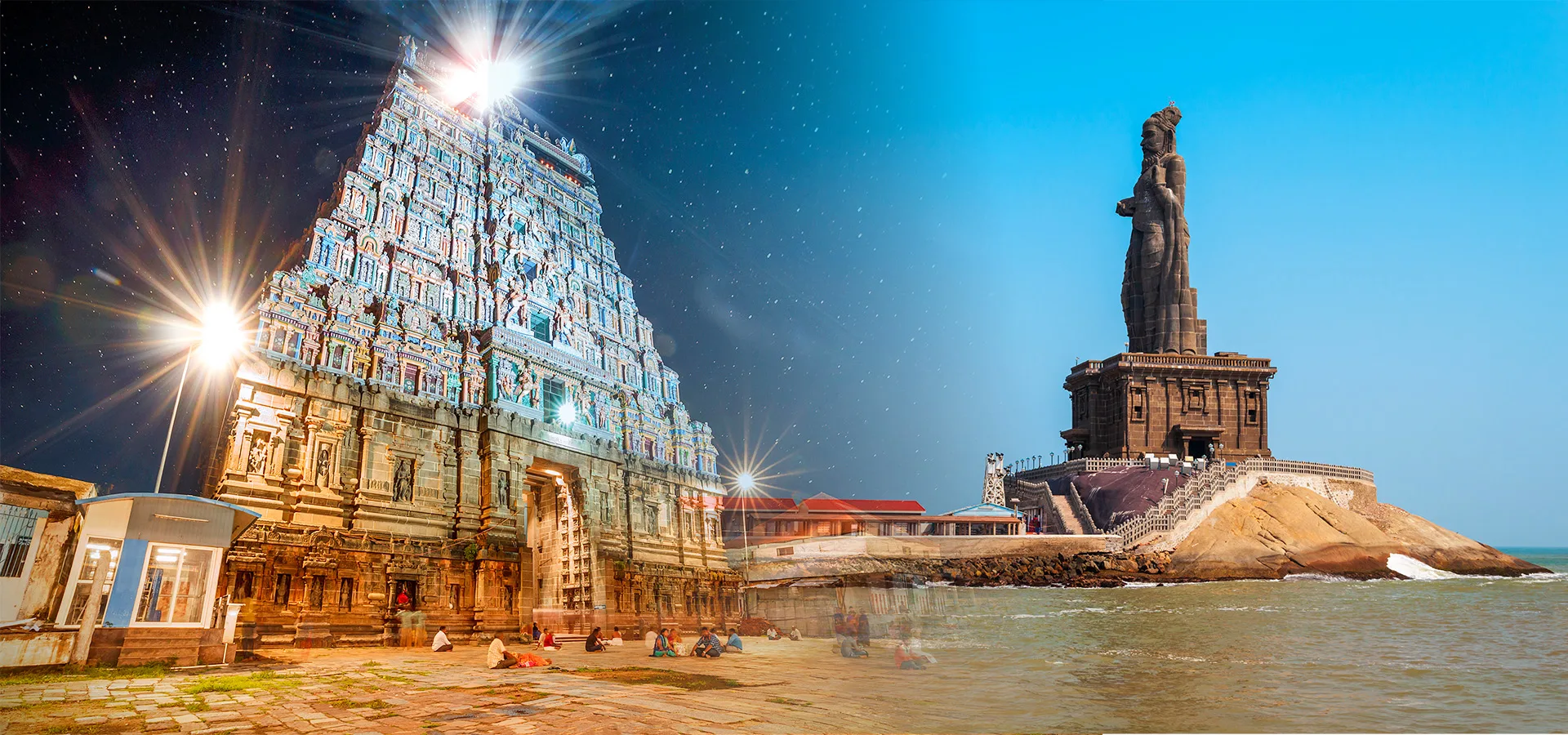
Morning in Pondicherry: Sri Aurobindo Ashram — one of the most influential spiritual communities in 20th-century India, founded in 1926 by Sri Aurobindo and The Mother; the samadhi (tomb) is a place of profound stillness. Auroville (10 km from Pondicherry) — an international township founded in 1968 built around the Matrimandir, a golden sphere used for silent meditation that is one of the most architecturally extraordinary buildings in India. Drive to Chidambaram (75 km). The Nataraja Temple — one of Hinduism's most sacred sites, where Shiva Nataraja performs the cosmic dance (Ananda Tandava) at the centre of the universe. The temple's 1,000-pillar hall and four great gopurams are extraordinary.
Morning: finish exploration of the Nataraja Temple — the dawn rituals are particularly atmospheric. Drive to Thanjavur (100 km, ~2.5 hrs), stopping at Gangaikondacholapuram — the largely forgotten former Chola capital where a magnificently preserved 11th-century Shiva temple (smaller than Thanjavur's Brihadeeswara but equally sophisticated) stands amid paddy fields. Arrive Thanjavur for the Brihadeeswara Temple — the crown jewel of Chola architecture (1010 CE, UNESCO World Heritage). The 66-metre vimana (tower) over the sanctum was the tallest structure in India when built; the entire complex is a masterpiece of Chola engineering, sculpture, and spatial composition. The Thanjavur Royal Palace and its Saraswati Mahal Library (containing 49,000 manuscripts) extend the day.
Morning: the Airavatesvara Temple at Darasuram (25 km from Thanjavur, UNESCO World Heritage) — a 12th-century Chola masterpiece where the entire chariot-shaped temple is carved in extraordinary detail; the stone musicians carved into the steps produce actual musical sounds when struck. Drive to Trichy (Tiruchirappalli, 55 km). The Rock Fort Temple — a remarkable temple complex built atop an 83-metre granite rock outcrop rising from the plains. At the summit, the Vinayaka Temple offers panoramic views across the city and the Kaveri River delta. Below in the Srirangam island, the Ranganathaswamy Temple — the largest functioning Hindu temple in the world (156 acres, 21 gopurams) and one of the 108 Divya Desams.
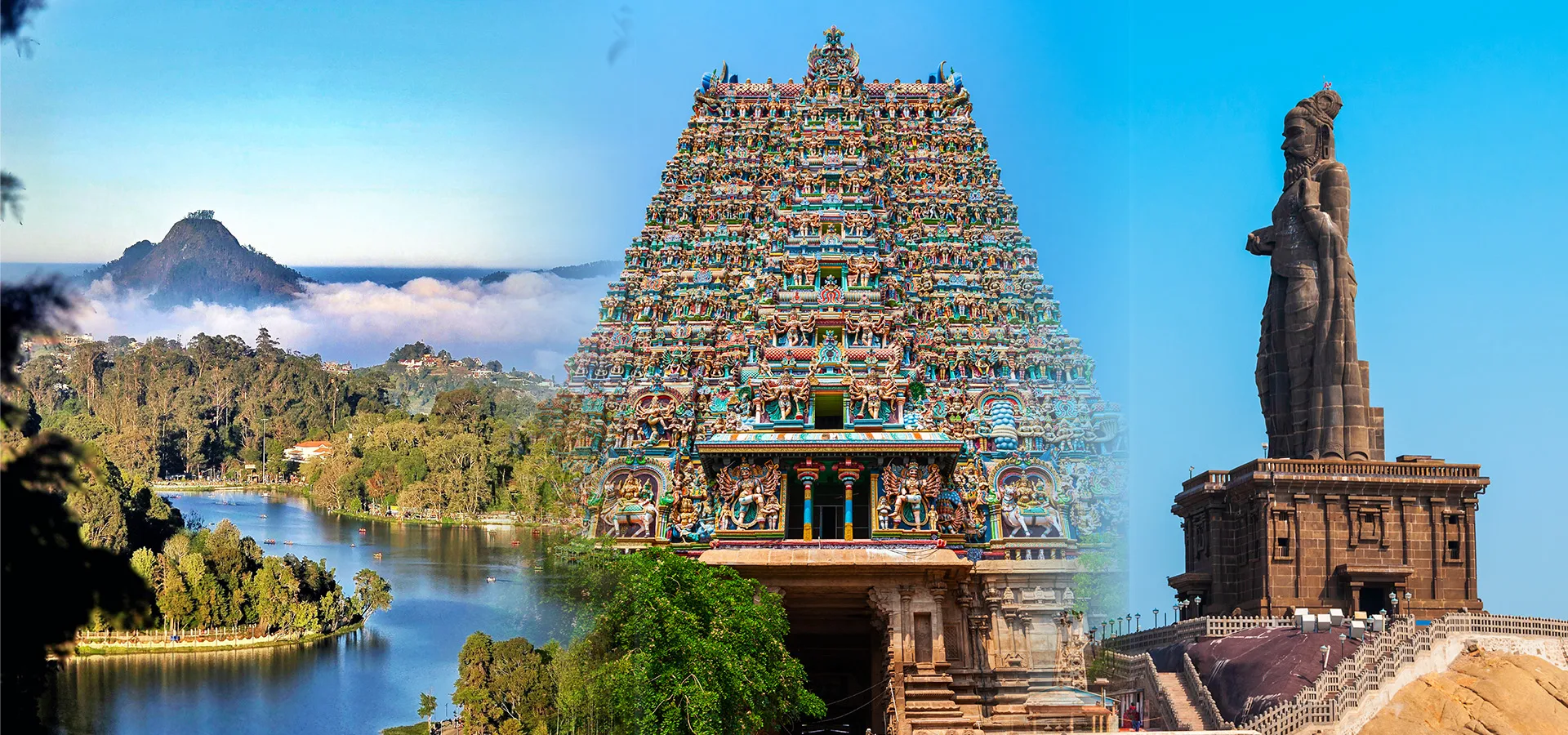
Morning: further exploration of the Ranganathaswamy Temple complex on Srirangam Island — a 156-acre walled city-temple with seven concentric enclosure walls, the innermost containing the principal shrine with its extraordinary 21-metre golden vimana. The outer enclosures contain bazaars, residences, and a complete urban settlement. Drive to Madurai (140 km, 2.5 hrs). Arrive and check in. First visit to the Meenakshi Amman Temple complex for the evening rituals — the atmosphere of 10,000 devotees, lamp-lit corridors, and chanting priests is extraordinary on a first encounter.
A full day in Madurai — the 'Athens of the East'. Return to Meenakshi Amman Temple at dawn for the morning rituals — intimate and deeply devotional compared to the busy afternoon. Explore the four gopurams, the Hall of a Thousand Pillars, the temple tank (Porthamarai Kulam), and the sacred corridor connecting Meenakshi to her consort Sundareswarar. The Thirumalai Nayak Palace (1636 CE) — extraordinary stucco columns and a vast 74x105-metre assembly hall. Gandhi Museum in the former Tamukkam Palace — the dhoti Gandhi was wearing when he was assassinated is among the exhibits. Evening: the Alangaram closing ceremony at the Meenakshi Temple.
Drive to Rameswaram (170 km, ~3.5 hrs) — crossing the Pamban Bridge, one of India's most dramatic railway bridges spanning the strait between the mainland and Pamban Island. Rameswaram is one of the Char Dham (four sacred Hindu pilgrimages of India), believed to be the point from which Lord Rama built his bridge (Ram Setu) to Lanka to rescue Sita. The Ramanathaswamy Temple is one of the 12 Jyotirlinga (sacred Shiva shrines) of India; its corridor of 1,212 metres — the longest temple corridor in the world — is lined with 1,000 pillars of extraordinary intricacy. The 22 sacred teerthams (water tanks within the temple) are central to the pilgrimage ritual. Excursion to Dhanushkodi — the ghost town at the island's tip, where the land narrows to a sand spit and Sri Lanka is visible across the Palk Strait on clear days.
Morning puja at the Ramanathaswamy Temple before checkout. Drive south to Kanyakumari (250 km, ~4.5 hrs) — through the southernmost districts of Tamil Nadu, the landscape dotted with windmills along the coast. Arrive at India's southern tip in time for the afternoon. Kumari Amman Temple (one of the 51 Shakti Peethas). Boat ride to Vivekananda Rock Memorial and the 133-foot Thiruvalluvar Statue. Sunset at the confluence of three seas — Arabian Sea, Bay of Bengal, and Indian Ocean — simultaneously visible from the tip of the land.
The most anticipated dawn on the tour: sunrise at Kanyakumari — the sun rising over the Bay of Bengal while the Arabian Sea glows to the west. Gandhi Smarak Mandapam — where Mahatma Gandhi's ashes rested before immersion, designed so that his birth date rays illuminate the exact spot annually. Drive to Trivandrum (90 km). The Sri Padmanabhaswamy Temple — one of the world's wealthiest and most sacred Vishnu temples, with its magnificent Dravidian gopuram. Napier Museum and Chitra Art Gallery (Raja Ravi Varma works).
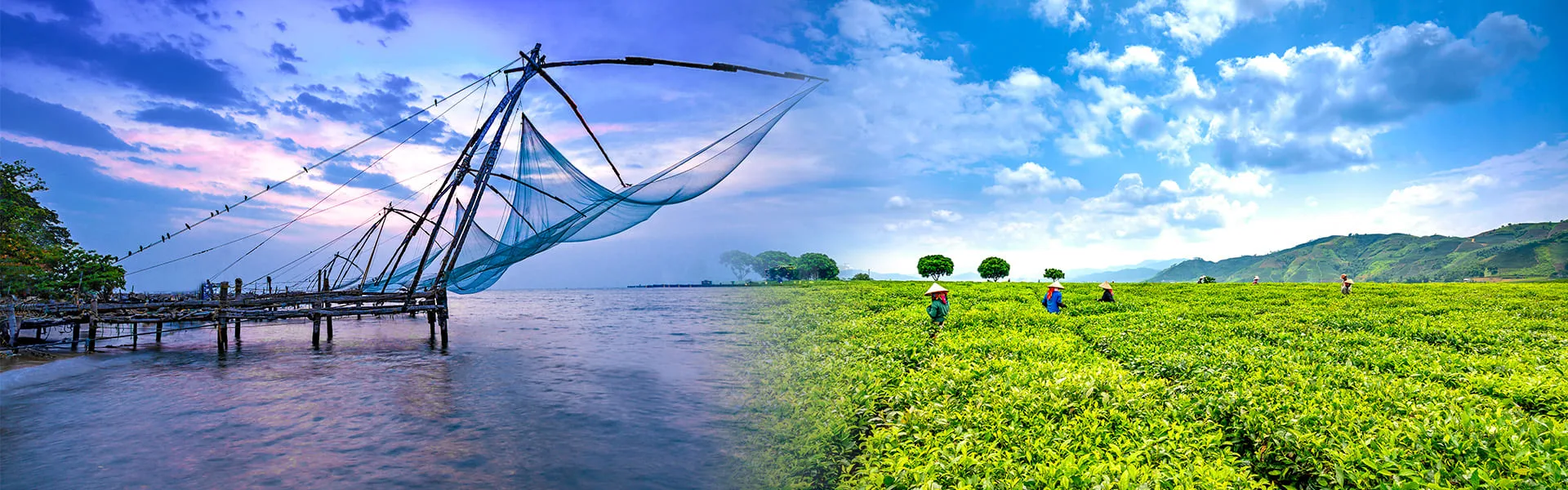
A final morning in Trivandrum — explore Kovalam Beach (16 km) or visit the Government Arts and Crafts Museum. Transfer to Trivandrum International Airport for your departure. Direct international connections to the Middle East, or connect via Mumbai/Kochi/Delhi for further destinations. The tour concludes here, or we can extend into Kerala's backwaters, Munnar's tea hills, and Fort Kochi's colonial harbour.
Inclusions & Exclusions
Included ✓
- ✓ 13 nights in handpicked 4/5-star hotels
- ✓ Daily breakfast throughout
- ✓ Dinner on Day 12 (Kanyakumari arrival)
- ✓ Private air-conditioned vehicle throughout
- ✓ English-speaking expert guide
- ✓ Mahabalipuram UNESCO guided tour
- ✓ Kanchipuram silk weaving visit
- ✓ Auroville Matrimandir guided visit
- ✓ Boat to Vivekananda Rock, Kanyakumari
- ✓ All applicable taxes & transfers
Not Included ✗
- ✗ Flights to Chennai / from Trivandrum
- ✗ Travel insurance (strongly recommended)
- ✗ Lunches throughout
- ✗ Tirumala special darshan tickets (TTD)
- ✗ Temple entry fees & camera charges
- ✗ Personal expenses & offerings
- ✗ Gratuities for guides & drivers
Your questions, answered
Yes, absolutely. Most of the great temples on this circuit are open to all sincere visitors regardless of faith. Tirumala requires a declaration of faith before entering the inner sanctum; Chidambaram and Brihadeeswara are fully open to all. Some temples (including parts of Madurai's Meenakshi and Srirangam's innermost shrine) restrict the sanctum sanctorum to Hindus, but the surrounding enclosures, corridors, and architecture are accessible to all. Your guide will advise at each site. Dress modestly (shoulders and knees covered) and be respectful — the temples are active places of worship, not museums.
The Nataraja Temple is one of the most important and theologically significant temples in Hinduism. It is dedicated to Shiva in his form as Nataraja (Lord of the Dance) — the cosmic dancer whose dance sustains the universe. What makes Chidambaram unique is the concept of Chidambara Rahasyam ('the secret of Chidambaram') — within the innermost sanctum there is no idol; the deity is represented by a curtain of golden vilva leaves concealing the space itself, symbolising the formlessness of Shiva. This is one of the Pancha Bhuta Stalas — the five temples representing the five elements; Chidambaram represents Space (Akash). It is considered by many Saivites to be the holiest place on earth.
Rameswaram is one of the four Char Dham pilgrimage sites of Hinduism (alongside Badrinath, Dwarka, and Puri) — meaning a devout Hindu is expected to visit all four in their lifetime. It is believed to be where Lord Rama worshipped Shiva before and after the battle of Lanka, and where he built his mythical bridge (Ram Setu) across the Palk Strait. The Ramanathaswamy Temple's corridor of 1,212 metres — the longest temple corridor in the world, lined with 1,000 magnificently carved pillars — and the 22 sacred water tanks within the complex make it an extraordinary architectural and spiritual site.
The TTD (Tirumala Tirupati Devasthanams) offers Special Entry Darshan tickets (₹300/person) bookable online at tirupatibalaji.ap.gov.in — typically 2–4 hours queue time (compared to 8–20 hours for free darshan). We strongly recommend booking these in advance. Various Seva tickets allow even closer access to the deity. Our team will guide you through the booking process when you confirm your tour, and will advise on the best option for your dates.
Absolutely. We can create a shorter version focusing on specific destinations — e.g. a 7-day Tamil Nadu temple circuit (Mahabalipuram, Kanchipuram, Chidambaram, Thanjavur, Trichy, Madurai) without Tirupati and Rameswaram. Or we can extend into Kerala for a combined temple and backwaters journey. Submit an enquiry with your preferred duration and highlights, and our specialists will redesign it for you.
October to March is ideal — comfortable temperatures across Tamil Nadu (25–32°C on the plains), post-monsoon greenery, and the festival season (Karthigai Deepam at Tiruvannamalai in November–December is spectacular). Avoid April–June (extreme heat, 38–42°C). The monsoon (June–September) can make some sites atmospheric but travel is more challenging. Tamil Nadu's festivals — Pongal (January), Navaratri (September–October), and Deepavali — are excellent times to experience temple culture at its most vibrant.