Jaipur was laid out in 1727 by Maharaja Sawai Jai Singh II according to ancient Vastu Shastra principles — one of India's earliest planned cities, built on a precise grid of nine rectangular blocks representing the nine divisions of the universe. It remains, to this day, one of the most architecturally coherent old cities anywhere in India.
In 1876, the entire old city was painted terracotta pink to welcome the Prince of Wales — a colour scheme the city has proudly maintained ever since (a municipal law still requires shopfronts in the walled city to keep the pink-ochre wash), giving Jaipur its enduring nickname and one of the most photogenic streetscapes in the country.
Tourism in Jaipur today rests on three pillars: its monuments (Amber Fort and the City Palace alone draw several million visitors a year), its position as the cornerstone of the Golden Triangle alongside Delhi and Agra, and its living craft economy — Jaipur remains India's gemstone-cutting capital and a global centre for block-printed textiles and blue pottery. UNESCO inscribed the Jantar Mantar observatory in 2010 and the Walled City itself as a World Heritage Site in 2019, recognition of a city that is as much a working urban centre as it is an open-air museum.
Jaipur sits at the edge of the Thar Desert, which makes its climate dramatically seasonal — timing your visit well makes a real difference to how much you enjoy the city.
Cool, dry, and ideal for sightseeing — daytime temperatures of 15–25°C, dropping to single digits on winter nights. The Jaipur Literature Festival (January) is the world's largest free literary festival and draws visitors internationally; book accommodation well ahead if your dates overlap.
Warm days but still comfortable mornings and evenings. Holi falls in March most years and Jaipur celebrates with particular colour and energy in the old city — a wonderful but very crowded time to visit.
Extreme heat through April, May, and June, regularly exceeding 42–45°C — outdoor sightseeing becomes genuinely difficult by mid-morning. The monsoon (July–September) brings welcome but unpredictable relief, with humidity and occasional flooding in the older parts of the city.
Nine landmarks — forts, palaces, gardens, and bazaars — that define a visit to the Pink City, each with everything you need to plan your stop.
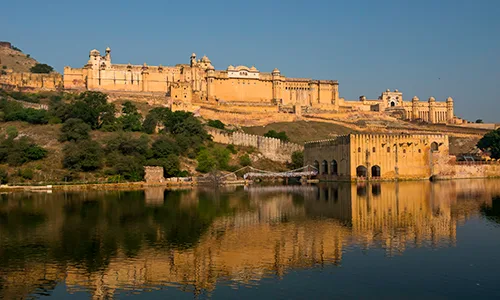
Fort
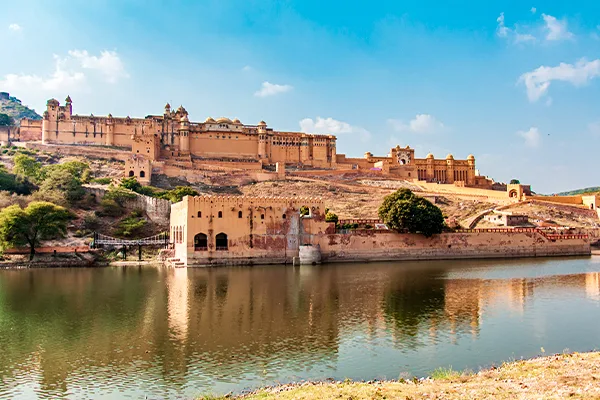
A hilltop fortress 11 km from the city, built over a century by successive Rajput rulers from honey-coloured sandstone and marble. Its mirrored Sheesh Mahal and terraced gardens are best seen at sunrise, before the crowds and the heat arrive.
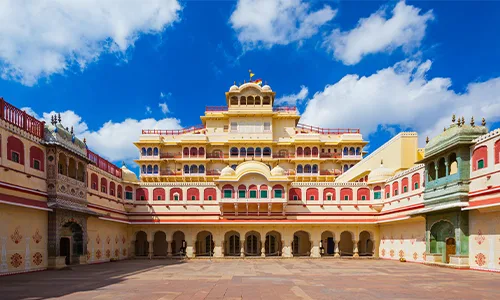
Palace
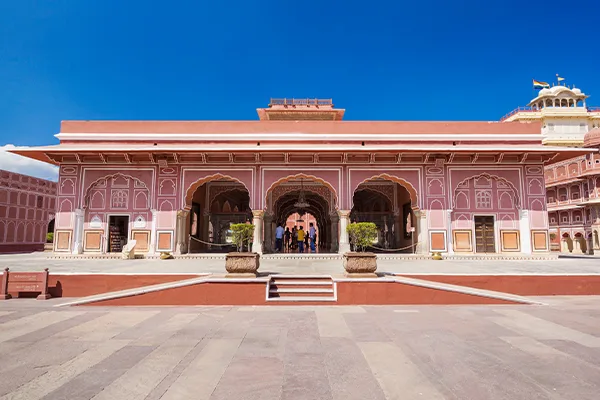
Still partly home to the Jaipur royal family, this sprawling complex in the heart of the old city blends Rajput and Mughal architecture across courtyards, museums, and the privately occupied Chandra Mahal.
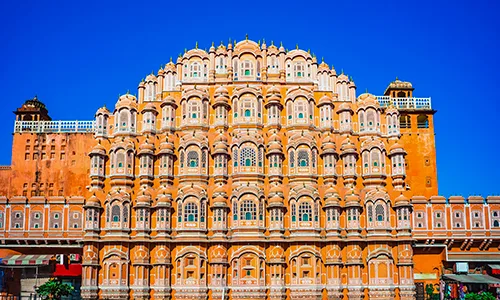
Landmark
The "Palace of Winds" — a five-storey honeycomb facade of 953 small windows, built in 1799 so the royal women could observe street life and festivals below unseen. Best photographed from the rooftop café directly opposite.
UNESCO Site
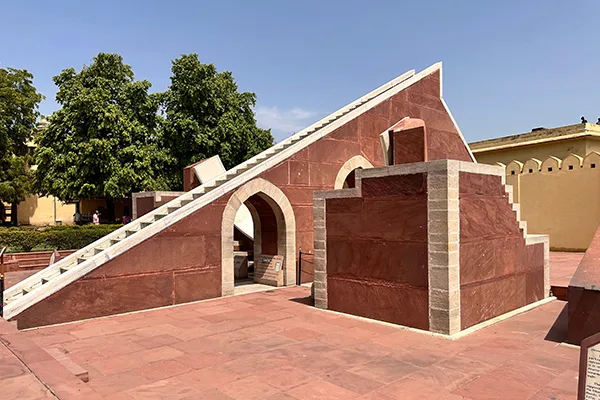
A UNESCO World Heritage astronomical observatory built in 1734 by Sawai Jai Singh II, containing nineteen instruments including the world's largest stone sundial — still accurate to within two seconds.
Viewpoint
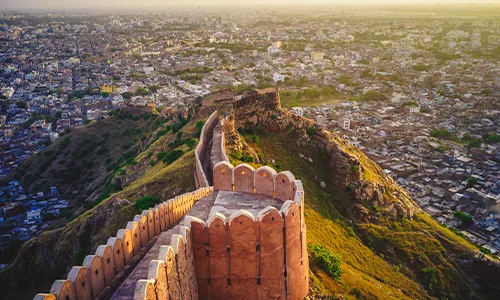
Perched on the Aravalli ridge above the city, Nahargarh offers Jaipur's finest sunset panorama — the whole Pink City laid out below as the light turns gold, with a rooftop café to linger over the view.
Palace
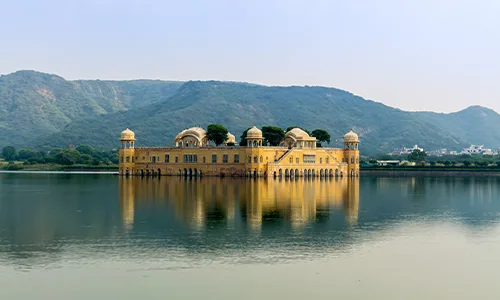
The "Water Palace" appears to float in the middle of Man Sagar Lake, with four of its five storeys submerged. Closed to visitors inside, but a beautiful photo stop and lakeside walk, especially at dusk.
Bazaar
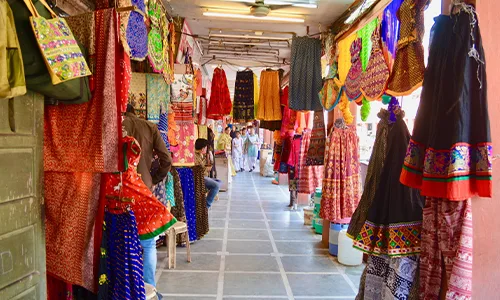
India's gemstone trading heart — narrow lanes of jewellers, lac bangle-makers, and tie-dye textile shops, largely unchanged in character for two centuries. The place to buy (carefully) or simply browse.
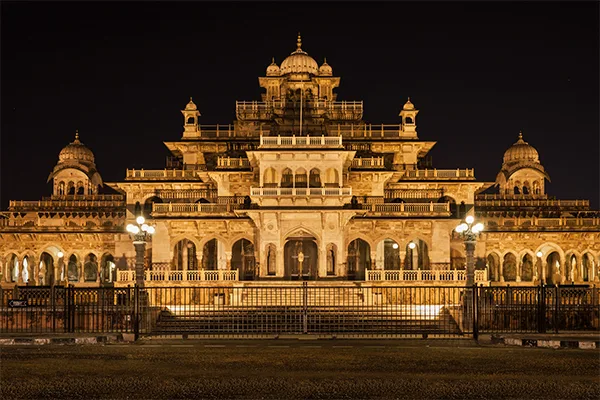
Museum
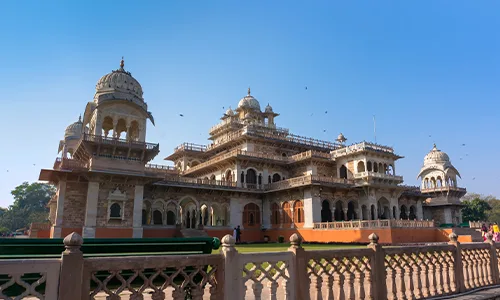
An Indo-Saracenic landmark set in the Ram Niwas Garden, housing Rajasthan's oldest museum — miniature paintings, metal sculptures, carpets, and an Egyptian mummy among its collection.
Experience
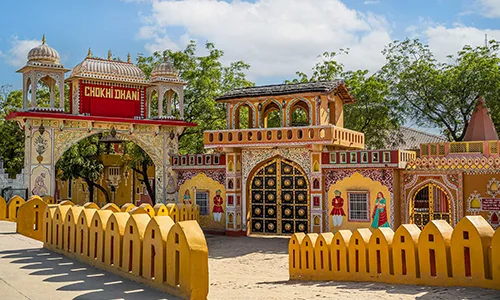
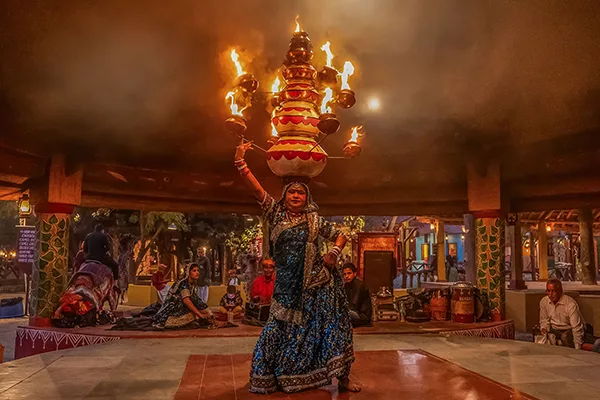
An evening recreation of rural Rajasthani life on the city's outskirts — folk dance, puppet shows, camel and elephant rides, and a traditional thali dinner served under the open sky.
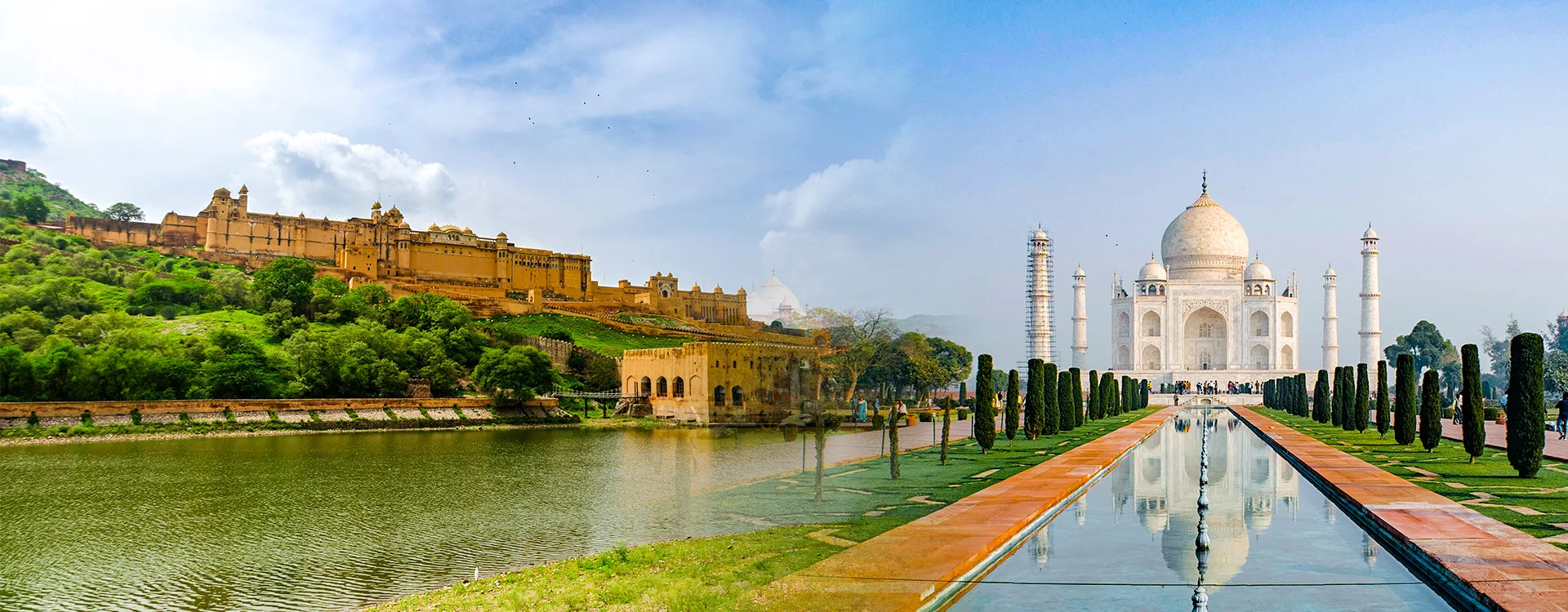
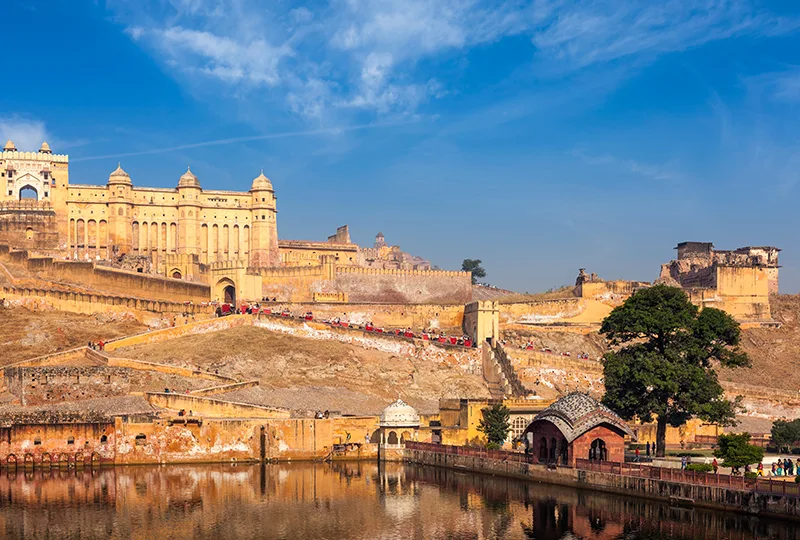
Eleven kilometres north of the city, Amber Fort rises from the Aravalli hills in honey-coloured sandstone and marble — best visited at first light, before the crowds and the heat arrive.
Jaigarh Fort above it once guarded the Jaipur royal treasury and houses the world's largest cannon on wheels, while Nahargarh Fort offers the finest sunset panorama over the entire Pink City.
The original 1727 grid plan survives almost intact — pink sandstone facades, seven fortified gates, and the City Palace and Hawa Mahal both within walking distance of each other.
Jantar Mantar's giant astronomical instruments sit directly beside the palace walls, making this compact core walkable in a single, rewarding day.
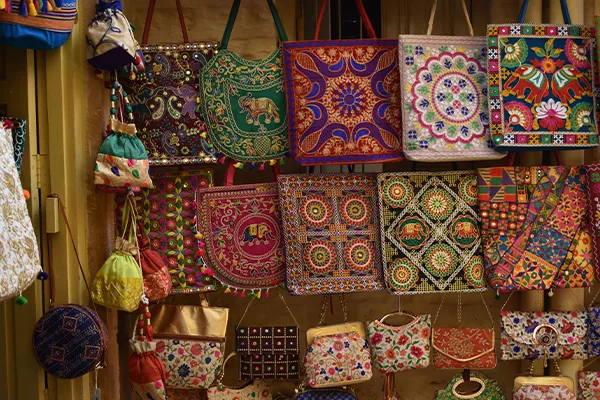
Jaipur's bazaars are organised by trade, exactly as the original city planners intended — gem dealers, textile printers, and metalworkers each occupying their own historic lane.
Day trips to Bagru and Sanganer reveal the block-printing villages that have supplied Jaipur's textile trade for five centuries.
Just beyond the city, Chokhi Dhani recreates rural Rajasthani village life for an evening of folk performance and traditional dining, while Galtaji's "Monkey Temple" hides natural spring-fed pools in a desert ravine.
These excursions round out a Jaipur stay with culture and nature beyond the monuments themselves.
Jaipur is exceptionally well connected — part of the reason it anchors the Golden Triangle alongside Delhi and Agra. Here's how to get there by air, rail, or road.
Jaipur International Airport (JAI) is 13 km from the city centre, with direct domestic flights from Delhi, Mumbai, Bangalore, and most major Indian cities, plus limited direct international connections to the Middle East.
Jaipur Junction is well served by express and superfast trains from Delhi, Mumbai, Agra, and Udaipur. The Shatabdi Express from Delhi is the fastest and most comfortable option for same-day travel.
The Delhi-Jaipur Expressway (NH48) makes for a smooth, scenic 5–5.5 hour private vehicle journey — the most popular way to combine Jaipur with Delhi and Agra on a Golden Triangle tour.
What to eat, and a few customs worth knowing, before you arrive
Rajasthan's signature dish — baked wheat rolls, spiced lentils, and sweet crumbled wheat, eaten together in one plate.
A fiery red mutton curry once cooked for royal hunting feasts, still a Rajasthani restaurant staple today.
A syrup-soaked Teej-festival sweet, and a thick clay-cup yoghurt drink — Jaipur's classic dessert and refreshment pairing.
Cover shoulders and knees when visiting temples and the City Palace — respectful, and sometimes required for entry.
In the bazaars, start at roughly half the quoted price and settle in the middle — it's part of the experience.
Especially in markets and rural areas — a simple gesture of courtesy that's almost always welcomed in return.
A few practical things worth knowing before you arrive in Jaipur.
A single composite ticket covers entry to Amber Fort, Jantar Mantar, Hawa Mahal, Nahargarh Fort, and several other monuments — better value than paying separately at each site.
Visit Amber Fort and Hawa Mahal at opening time (around 8–9 AM) to avoid both the worst heat and the heaviest tour-bus crowds, especially November to February.
Elephant rides up to Amber Fort remain available but are increasingly discouraged on animal welfare grounds — a 4x4 jeep or simply walking up are both excellent, more responsible alternatives.
Jaipur's dry desert-edge climate dehydrates faster than you'd expect, even in winter. Carry water on every sightseeing day, particularly at hilltop forts with little shade.
Pre-paid taxis and ride-hailing apps (Uber, Ola) work well for longer hops; auto-rickshaws and cycle-rickshaws are better suited to short distances within the walled city.
For gemstones and jewellery, buy only from government-approved emporiums or well-reviewed established shops, and always ask for a certificate of authenticity.
The Jaipur Literature Festival (January), Elephant Festival (March, around Holi), and Teej (July/August) all transform the city — wonderful to witness, but book accommodation early.
Jaipur is generally safe for travellers, but as in any major tourist city, be alert for unofficial "guides" near major monuments and agree any price clearly before a service begins.