Twelve Destinations, Three Thousand Years of Dravidian Craft
This is the definitive circuit through Tamil Nadu's own temple-building lineage — a 14-day journey tracing Dravidian architecture from its earliest Pallava rock-cut beginnings at Mahabalipuram to its mature Chola expression at Thanjavur, and on to the living, still-worshipped complexes at Madurai and Rameswaram.
Where many South India temple tours route through Andhra Pradesh's Tirupati, this itinerary stays rooted in Tamil Nadu, adding Tiruvannamalai and the Chola temple cluster around Kumbakonam — both essential to understanding how Dravidian architecture actually evolved, and both frequently skipped on shorter circuits.
The Dravidian style itself — soaring, sculpture-covered gopurams, stepped pyramidal towers over each sanctum, concentric walled enclosures, and a sacred temple tank — reached its defining form here, under Pallava, Chola, and Pandya patronage between the 7th and 13th centuries. Nowhere else on earth is that tradition so concentrated or so unbroken.
This is not a sightseeing checklist. It is a slow, considered journey through the oldest continuously living religious architecture on the planet.
What makes this journey special
Your journey, unfolded
Welcome to South India! Your Discover India representative meets you at Chennai International Airport and transfers you to your hotel. The afternoon is free — explore the environs of your hotel, or take an evening walk to Marina Beach, 13km of golden sand along the Bay of Bengal and the world's second-longest urban beach.
A morning visit to Kapaleeshwarar Temple, Chennai's finest example of Dravidian architecture, dedicated to Shiva and dating largely to the 7th century, its colourful gopuram rising above the Mylapore neighbourhood. Afterward, drive south to Mahabalipuram, the ancient Pallava port town.
In the afternoon, visit the UNESCO World Heritage Shore Temple, built by the Pallava dynasty in the 8th century directly on the Bay of Bengal shoreline, and the Pancha Rathas — five monolithic rock-cut temples, each carved from a single boulder.
A final morning in Mahabalipuram to see Arjuna's Penance, the world's largest bas-relief carving, cut directly into a giant rock face and depicting scenes from the Mahabharata. Then drive inland to Kanchipuram, one of Hinduism's seven sacred cities, historically known as the City of a Thousand Shrines.
In the afternoon, visit the Kailasanatha Temple, built around 700 CE and the oldest structure in Kanchipuram, and the Ekambareswarar Temple, one of the Pancha Bhuta Sthalams representing earth, its 59-metre gopuram among the tallest in Tamil Nadu.
A morning visit to a working Kanchipuram silk weaving workshop — the town has been synonymous with silk saree weaving for centuries — before driving south to Tiruvannamalai, at the foot of the sacred Arunachala hill.
In the afternoon, visit the Arunachaleswarar Temple, one of the Pancha Bhuta Sthalams representing fire (Agni), built by the Cholas from the 9th century, with a temple tank containing 360 sacred tirthas. If timing allows, walk part of the Girivalam — the 14km circumambulation path around Arunachala hill, walked by pilgrims for centuries.
Drive east to Chidambaram, home to one of Hinduism's most theologically significant temples. The Nataraja Temple is dedicated to Shiva as Nataraja, the cosmic dancer, and represents Akash (space/ether) among the five Pancha Bhuta Sthalams.
Its innermost sanctum famously holds no idol — the deity is represented by a curtain of golden vilva leaves concealing empty space, a concept known as Chidambara Rahasyam. The temple's wall carvings depict all 108 karanas of classical dance from the Natya Shastra, forming the foundation of Bharatanatyam.
Drive to Kumbakonam, a town so dense with Chola-era temples it's sometimes called the temple town of the Kaveri delta. Visit the Adi Kumbeswarar Temple, praised in the 7th-century Tevaram scripture, its complex spread across 30,000 square feet with four gopurams — the tallest rising 128 feet across 11 storeys.
Inside, a sixteen-pillared hall built during the Vijayanagara period has all 27 nakshatras (lunar stars) and 12 zodiac signs sculpted into a single stone. Time permitting, a short excursion to nearby Darasuram's Airavatesvara Temple, another Chola masterpiece, rounds out the afternoon.
A short drive to Thanjavur, capital of the Chola empire at its height. The Brihadeeswarar Temple, a UNESCO World Heritage Site completed in 1010 CE under Raja Raja Chola I, is the undisputed masterpiece of Dravidian architecture — its vimana rises 66 metres, capped by a single 80-tonne granite block, without any modern lifting equipment.
The afternoon is free to explore Thanjavur's old town, including the Saraswati Mahal Library, one of the oldest libraries in Asia, holding rare palm-leaf manuscripts.
Drive to Tiruchirappalli (Trichy), where the Rock Fort Temple sits atop an 83-metre outcrop of some of the oldest exposed rock on earth, offering sweeping views over the Kaveri River. Climb the 400-odd steps (or take it at your own pace) to the summit shrine.
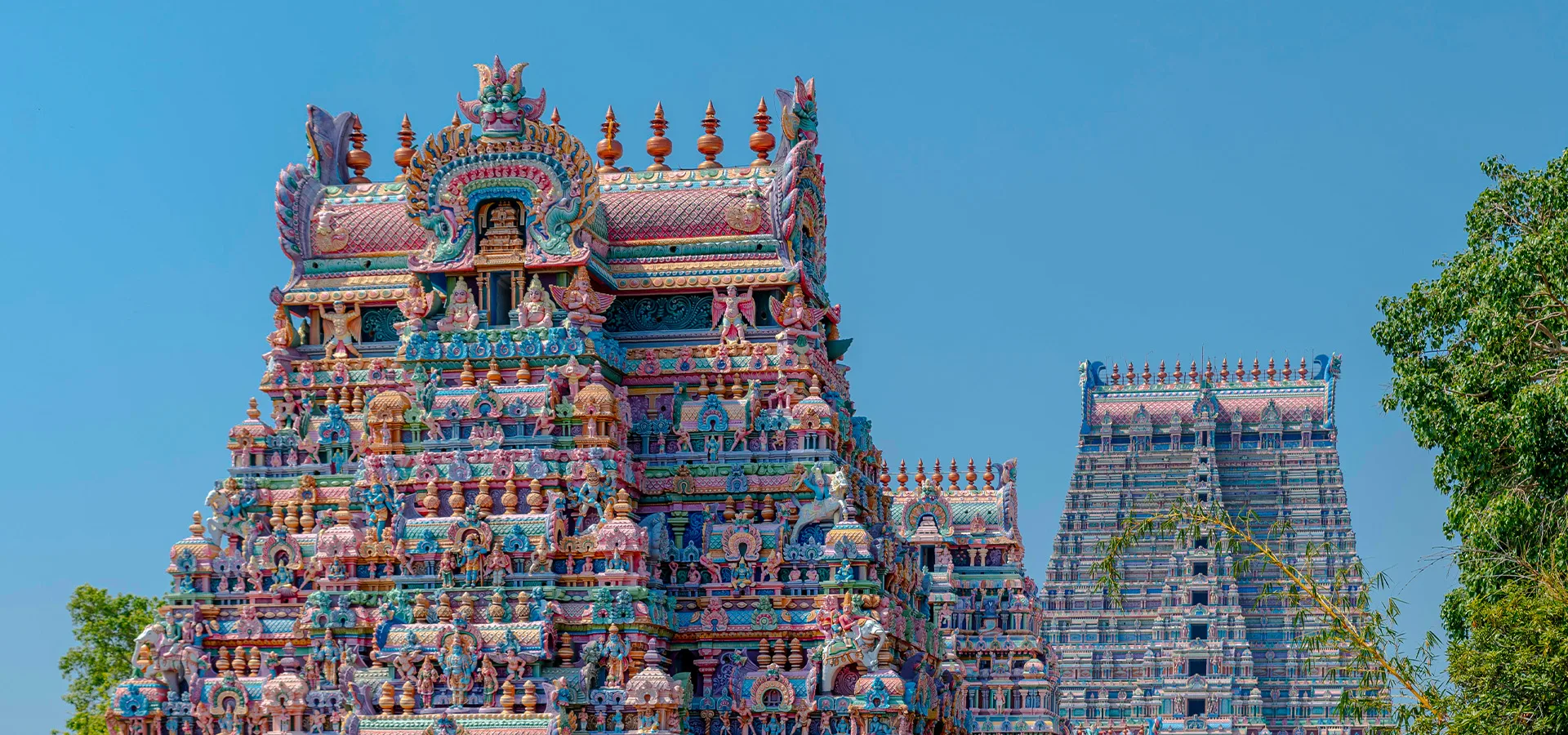
In the afternoon, visit Srirangam's Ranganathaswamy Temple, one of the largest functioning Hindu temple complexes in the world, spread across 156 acres with seven concentric enclosures (prakarams) and 21 towering gopurams.
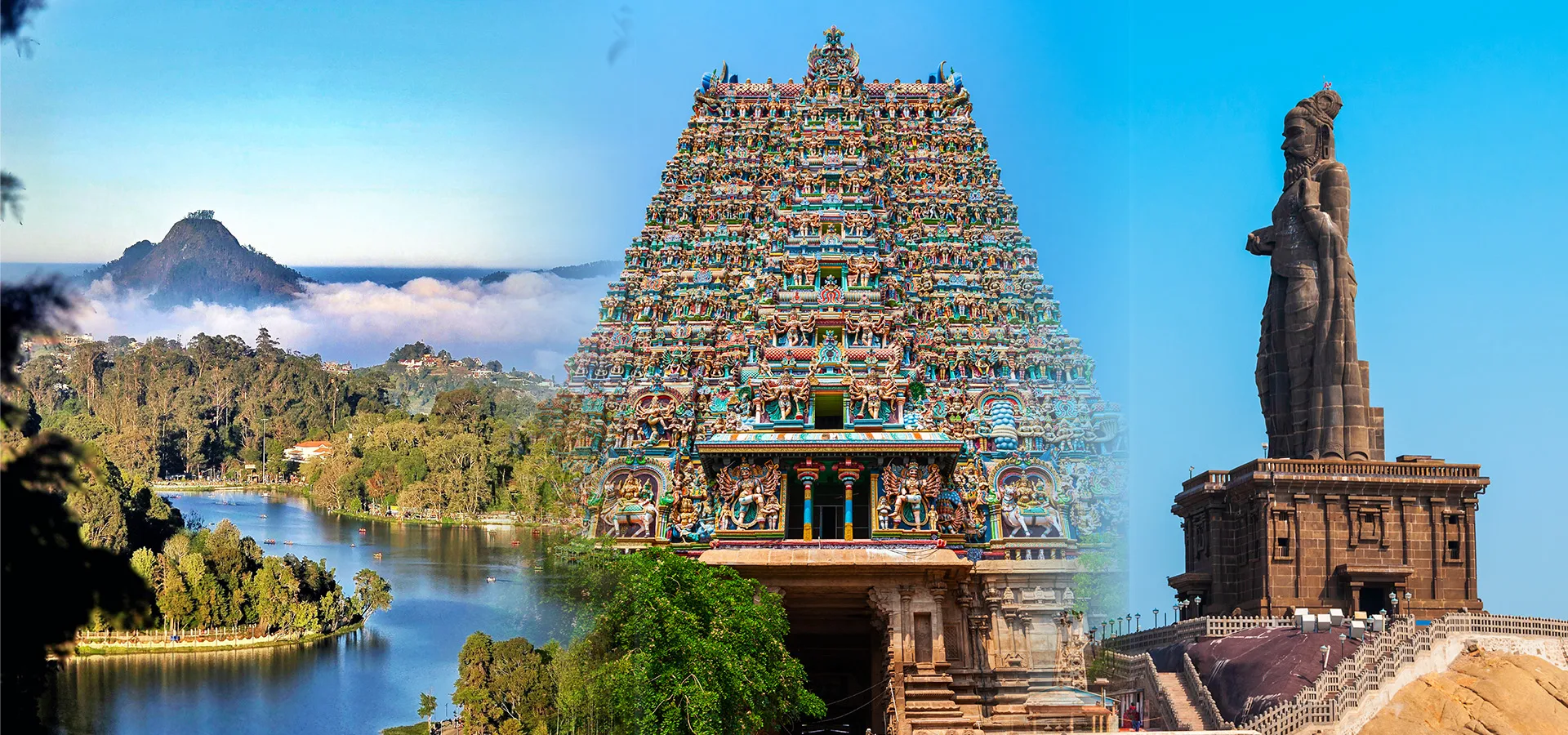
Drive south to Madurai, one of India's oldest continuously inhabited cities. The Meenakshi Amman Temple, dedicated to Parvati as Meenakshi and her consort Sundareswarar (Shiva), is among the greatest living temple complexes in India — 12 gopurams, the tallest over 51 metres, covered in an estimated 33,000 painted sculptures.
The temple remains a genuinely active place of worship, drawing an estimated 15,000 visitors daily; evening brings a particularly striking golden-hour view of the illuminated gopurams.
A full day to explore Madurai beyond the temple. Visit the Thirumalai Nayakkar Palace, a 17th-century Indo-Saracenic palace built by the Nayak dynasty, and the Gandhi Memorial Museum, housing the blood-stained garment Mahatma Gandhi wore at the time of his assassination.
In the afternoon, wander Madurai's flower and spice markets around the temple, among the most vivid and photogenic in Tamil Nadu, before a final evening visit to the temple for the closing rituals.
Drive to Rameswaram, on Pamban Island, connected to the mainland by the Pamban Bridge. Rameswaram is one of the four Char Dham pilgrimage sites of Hinduism, believed to be where Lord Rama worshipped Shiva before crossing to Lanka.
The Ramanathaswamy Temple's corridor — at 1,212 metres, the longest temple corridor in the world, lined with over 1,000 carved pillars — and its 22 sacred wells, each believed to have a different taste, make this one of the most architecturally distinctive temples on the entire circuit.
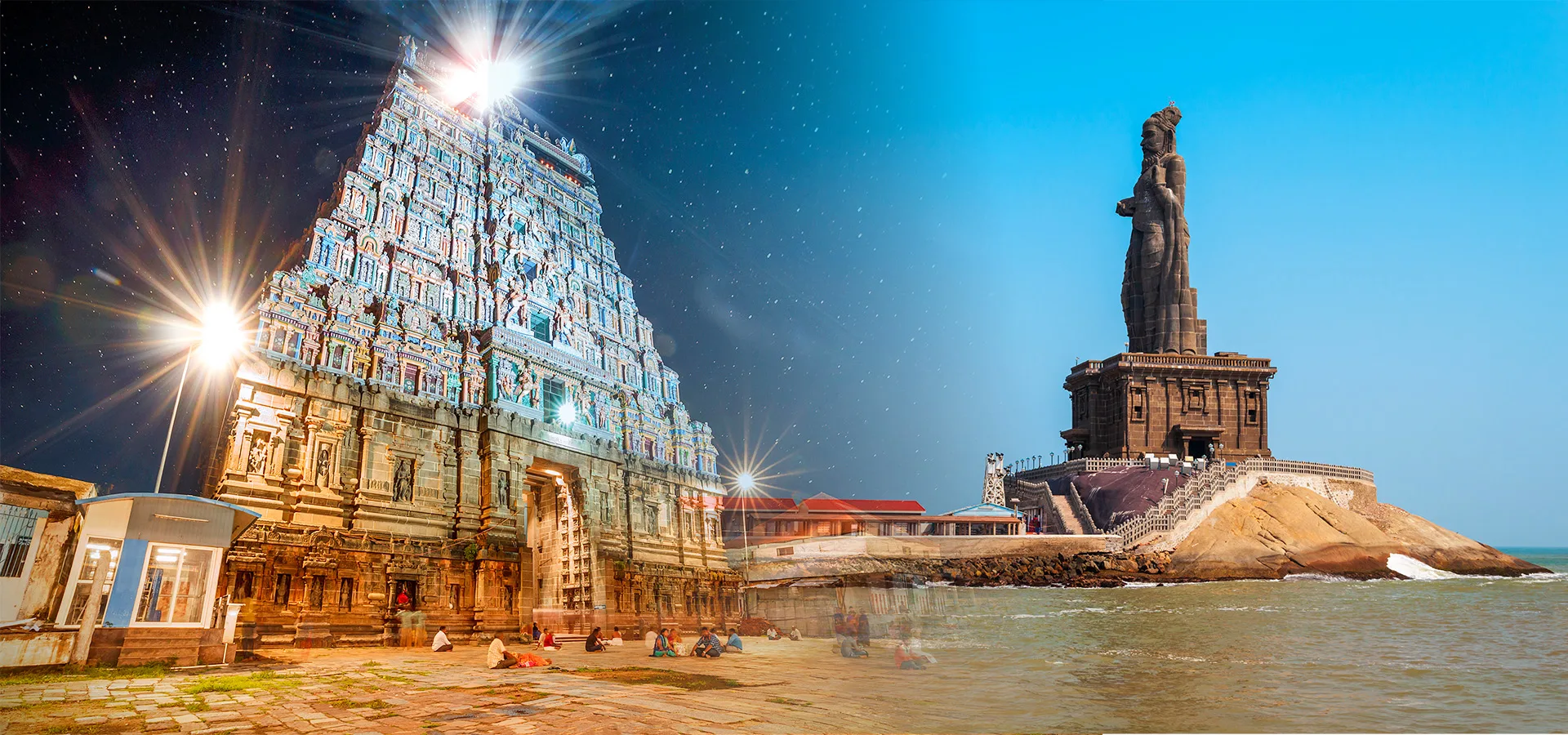
Drive to Kanyakumari, at India's southernmost tip, where the Bay of Bengal, the Arabian Sea, and the Indian Ocean are said to converge. Visit the Kanyakumari Amman Temple, dedicated to the virgin goddess Devi Kanya, right on the shore.
In the late afternoon, take the ferry out to Vivekananda Rock Memorial, built on the rock where Swami Vivekananda is said to have meditated in 1892 before his famous Chicago address, with panoramic views across the meeting point of the three seas.
An early start for sunrise at Kanyakumari — one of the few places in India where, on clear days around full moon, both sunrise and moonset can be seen simultaneously over the water. After breakfast, drive across the state line into Kerala, arriving in Trivandrum (Thiruvananthapuram) by early afternoon.
The remainder of the day is free — visit the Padmanabhaswamy Temple if time and dress-code permit, or simply relax after a demanding two-week circuit.
A relaxed final morning before transferring to Trivandrum International Airport for your onward flight. Tour concludes — fourteen days, twelve destinations, and three thousand years of Dravidian temple-building tradition, from Pallava rock-cut shrines to living Chola masterpieces still in daily worship.
Inclusions & Exclusions
Included ✓
- ✓ 13 nights in handpicked 3/4-star hotels
- ✓ Daily breakfast throughout
- ✓ Private air-conditioned vehicle throughout
- ✓ English-speaking expert guide
- ✓ Mahabalipuram UNESCO guided tour
- ✓ Kanchipuram silk weaving visit
- ✓ Vivekananda Rock ferry, Kanyakumari
- ✓ All applicable taxes & transfers
Not Included ✗
- ✗ Flights to Chennai / from Trivandrum
- ✗ Travel insurance (strongly recommended)
- ✗ Lunches & dinners throughout
- ✗ Temple entry fees & camera charges
- ✗ Personal expenses & offerings
- ✗ Gratuities for guides & drivers
Your questions, answered
Dravidian architecture is the temple-building style that developed in South India, distinct from the North Indian Nagara style. It's defined by soaring, sculpture-covered gopurams (gateway towers) rather than a single central spire, a stepped pyramidal vimana over the sanctum, concentric walled enclosures (prakarams), and a sacred temple tank. It reached its peak under the Chola, Pallava, and Pandya dynasties between the 7th and 13th centuries — the exact period this tour traces, from Mahabalipuram's early Pallava rock-cut shrines to Thanjavur's mature Chola masterpiece.
This itinerary is built specifically around Dravidian temple architecture and Tamil Nadu's Chola heartland — Tirupati's Venkateswara Temple, while immensely significant, sits just across the border in Andhra Pradesh and follows a different architectural tradition. Tiruvannamalai's Arunachaleswarar Temple (one of the five Pancha Bhuta Sthalams, representing fire) and Kumbakonam's cluster of Chola-era temples are included instead, for travellers who want to go deeper into Tamil Nadu's own temple-building lineage rather than a broader multi-state pilgrimage. If you'd prefer Tirupati included, see our Sacred Temples of South India itinerary instead.
Chidambaram is one of the Pancha Bhuta Sthalams — the five temples representing the five elements — and represents Akash (space/ether). Its innermost sanctum famously contains no idol; the deity is represented by a curtain of golden vilva leaves concealing an empty space, a concept called Chidambara Rahasyam (“the secret of Chidambaram”), symbolising the formlessness of Shiva. The temple's wall carvings depict all 108 karanas (dance postures) from the Natya Shastra, forming the classical foundation of Bharatanatyam.
Yes. Most temples on this circuit welcome all sincere visitors into their outer halls, corridors, and architecture regardless of faith — Chidambaram and Brihadeeswarar are fully open to everyone. Some inner sanctums (parts of Madurai's Meenakshi Temple and Srirangam's innermost shrine near Trichy) are restricted to Hindus, but the surrounding structures remain accessible. Dress modestly (shoulders and knees covered) and be respectful throughout — these are active places of worship, not museums.
October to March, when daytime temperatures across Tamil Nadu stay in a comfortable 25–32°C range. Tiruvannamalai's Karthigai Deepam festival (November–December) is genuinely spectacular if your dates align with it. Avoid April–June, when temperatures regularly reach 38–42°C on the plains.
Yes, easily. A shorter 7–8 night version focusing purely on Mahabalipuram, Kanchipuram, Chidambaram, Thanjavur and Madurai is a popular trim. Alternatively, since this tour already ends in Trivandrum, extending directly into Kerala's backwaters and hill country is a natural next step — just let us know when enquiring.