India's Second-Largest Mangrove Forest, and a Beach Where the Sea Disappears
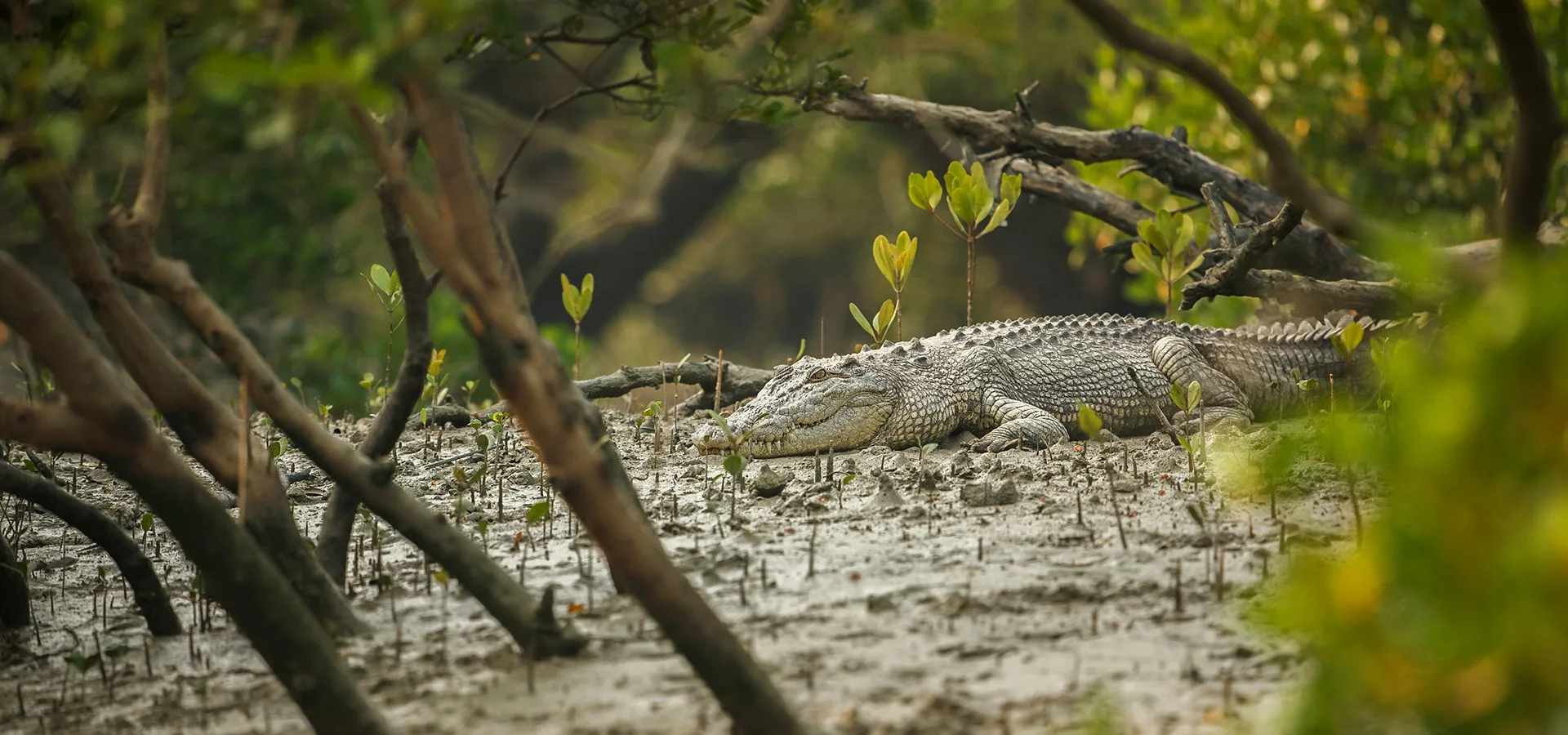
A 5-day journey into Odisha's wildest coastal landscapes — Bhitarkanika National Park, India's second-largest mangrove ecosystem and home to the country's largest population of saltwater crocodiles, and Chandipur, a genuinely unusual beach where the sea recedes up to 5 km at low tide, earning it the nickname the 'vanishing sea'.
The journey opens with the drive to Bhitarkanika via Kendrapara, followed by a boat safari deep into the mangrove creeks — Bhitarkanika holds India's largest population of saltwater crocodiles (including some of the largest individuals recorded anywhere), alongside water monitors, king cobras, and over 215 recorded bird species.
A second day allows a possible excursion (seasonal, January-March) toward Gahirmatha Beach, the world's largest nesting ground for Olive Ridley sea turtles, where hundreds of thousands of turtles come ashore to lay eggs — one of the most significant marine conservation sites in India.
From Bhitarkanika, the route continues to Chandipur, where the Bay of Bengal recedes dramatically at low tide, exposing kilometres of flat sandy seabed that visitors can walk across — a genuinely unique coastal phenomenon found at very few beaches in the world, before the journey concludes back at Bhubaneswar.
What makes this journey special
Your journey, unfolded
Welcome to Odisha! On arrival, drive to Bhitarkanika National Park (approximately 140 km via Kendrapara, ~3.5 hours). On arrival at the jetty (Khola/Gupti), check in to your nature camp or guesthouse near Dangmal. Evening at leisure to settle into the park's quiet, riverine surroundings.
A full day boat safari deep into Bhitarkanika's mangrove creeks — India's second-largest mangrove forest, and home to the country's largest population of saltwater crocodiles, some among the largest recorded anywhere. Visit the Dangmal Crocodile Research and Conservation Centre to learn about the park's long-running conservation programme. Keep watch for water monitors, king cobras, and the park's exceptional birdlife, including white-bellied sea eagles and openbill storks.
Morning, weather and season permitting (January-March), an optional excursion toward Gahirmatha Beach, the world's largest mass nesting site for Olive Ridley sea turtles. After breakfast, check out and drive to Chandipur (approximately 220 km, ~5 hours). On arrival, check in to your hotel, with the evening free to witness the tide receding over Chandipur's famously flat shore.
Time your visit to the beach around low tide, when the Bay of Bengal recedes up to 5 km, exposing a vast, flat expanse of sandy seabed that visitors can walk across — a genuinely unusual coastal phenomenon found at very few beaches anywhere in the world. In the afternoon, visit the Panchalingeswar Temple, a 16th-century shrine set amid forested hills about 16 km from Chandipur, with five Shiva lingams housed within a natural rock formation.
A final morning by the sea, timed if possible around the tide. After breakfast, check out and drive back to Bhubaneswar (approximately 220 km, ~5 hours) for your departure flight or train. Tour concludes.
Inclusions & Exclusions
Included ✓
- ✓ 4 nights accommodation on twin/triple-share basis (nature camp/guesthouse at Bhitarkanika, hotel at Chandipur)
- ✓ Buffet meals as specified in the itinerary
- ✓ Private chauffeur-driven AC vehicle for all road transfers
- ✓ Mangrove boat safari at Bhitarkanika
- ✓ Bhitarkanika National Park entry permits
- ✓ 1 bottle of mineral water per person per day
- ✓ All applicable Indian GST
Not Included ✗
- ✗ International/domestic airfare or train fare to/from Bhubaneswar
- ✗ Visa charges
- ✗ Gahirmatha excursion (optional, seasonal, payable locally subject to availability)
- ✗ Entrance fees / camera charges at temples and attractions
- ✗ Tipping — an entirely personal gesture
- ✗ Laundry, drinks, and items of a personal nature
Your questions, answered
October to February offers the most comfortable temperatures (18–28°C) for temple visits, lagoon cruises, and wildlife sightings. March–May is hot and humid (up to 40°C); the monsoon (June–September) brings heavy rain to the coast and can affect access to Bhitarkanika and the hill stations, though Daringbadi's waterfalls are at their fullest during this period.
Absolutely. Every Discover India tour is fully private and built around your preferences. We can adjust the duration, add Nandankanan Zoological Park, or extend any coastal or wildlife stop. Submit an enquiry and our specialists will tailor it for you at no obligation.
Cancellations 60+ days before departure receive a full refund minus a small admin fee. 30–59 days: 75% refund. 15–29 days: 50% refund. Under 15 days: no refund. We strongly recommend comprehensive travel insurance.
October to March offers the most comfortable temperatures (15–28°C) for the ghats, boat rides, and temple queues. April–June is hot on the Gangetic plain (up to 42°C); the monsoon (July–September) raises the Ganges considerably, which can affect ghat access in both cities.
The new Ram Janmabhoomi Mandir draws very large crowds, particularly on weekends and during festivals such as Ram Navami and Diwali. We schedule darshan with queue time built into the itinerary; carrying a valid photo ID is recommended, as security screening is in place at the main temple complex.
Absolutely. Every Discover India tour is fully private and built around your preferences. We can adjust the duration, add Lucknow, or swap Chitrakoot for additional time in Prayagraj. Submit an enquiry and our specialists will tailor it for you at no obligation.
Cancellations 60+ days before departure receive a full refund minus a small admin fee. 30–59 days: 75% refund. 15–29 days: 50% refund. Under 15 days: no refund. We strongly recommend comprehensive travel insurance.