Sacred Confluences, Alpine Meadows & a UNESCO World Heritage Valley of Wildflowers
A 6-day trekking journey to one of the Himalaya's most celebrated natural wonders — the Valley of Flowers, a UNESCO World Heritage Site whose alpine meadows burst into an extraordinary diversity of wildflowers each monsoon season.
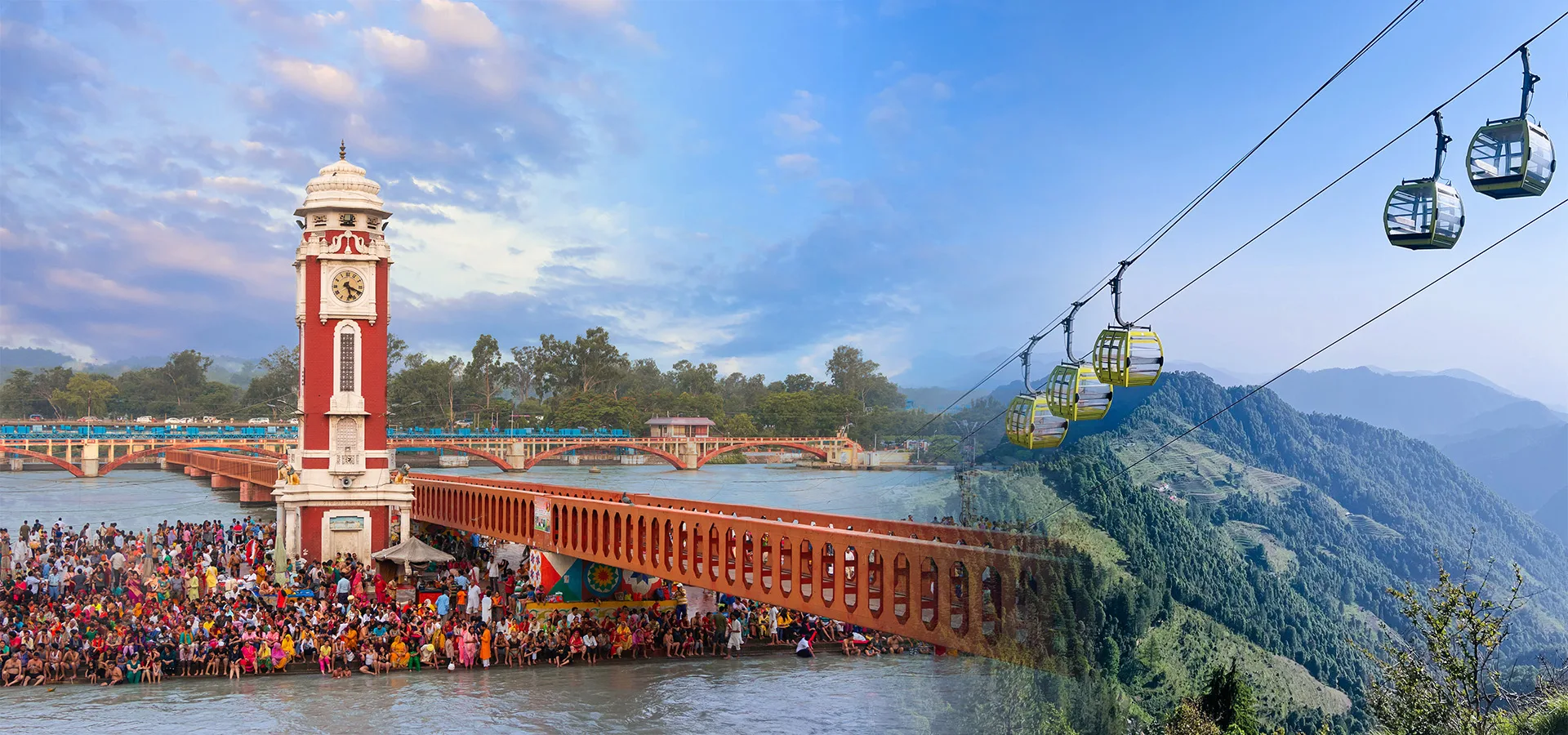
The journey begins with a drive from Delhi to Rishikesh, with an evening at the Ganga ghats to witness the famous Aarti ceremony on the banks of the river. The following day's drive to Joshimath passes through four sacred river confluences — Devprayag, Rudraprayag, Karnaprayag, and Nandprayag — each marking the meeting of two Himalayan rivers.
From Joshimath, an early drive to Govindghat begins the trek proper — crossing the Alaknanda River and walking through forest and villages in the Bhyundar Valley, past numerous waterfalls and lush green landscape, to reach Ghangria (14 km, moderate gradient, 4-5 hours, with mule or helicopter options available for those who prefer not to walk the full distance).
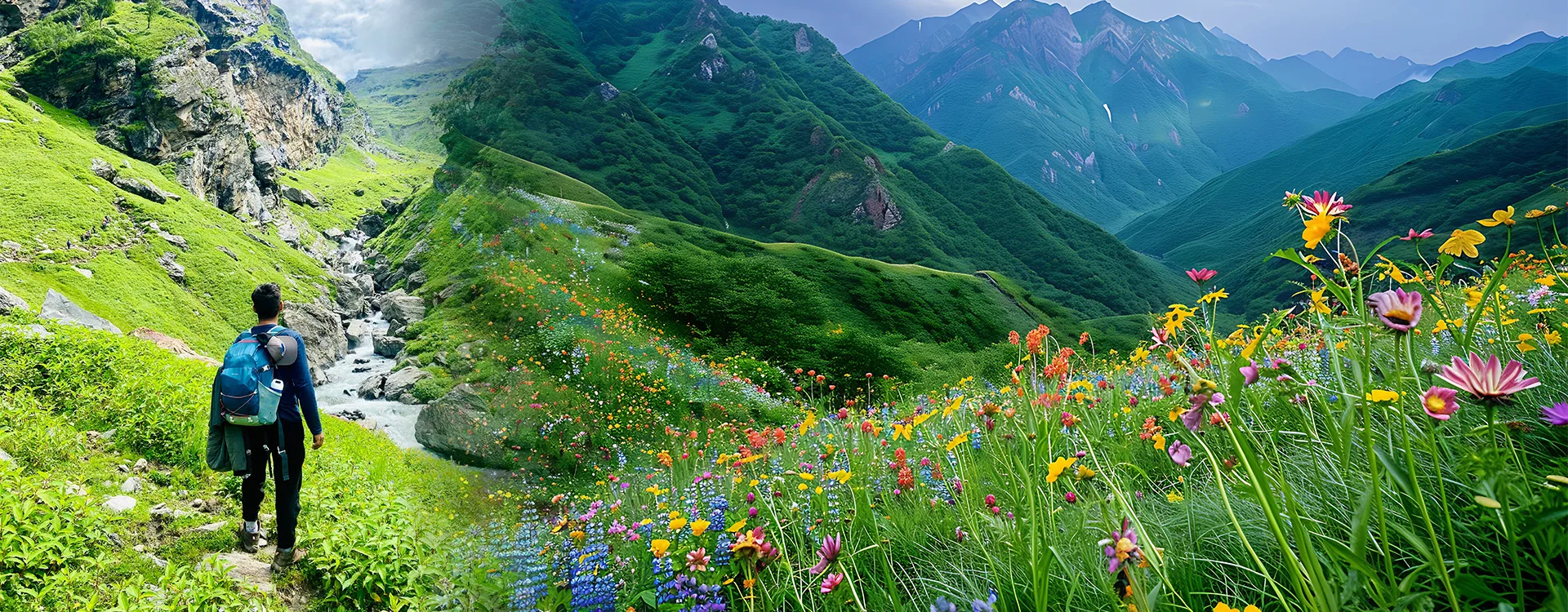
The valley itself is reached by a shorter, soothing ascent from Ghangria — unending alpine meadows filled with Brahma Kamal, anemone, geranium, marsh marigold, primula, lilium, and dozens of other Himalayan wildflower species, framed by the snow-clad Ratban Parvat and the dense birch forests of the surrounding hillsides. After two nights based at Ghangria, the journey retraces its steps to Joshimath and on to Delhi.
What makes this journey special
Your journey, unfolded
Arrive at Delhi Airport or railway station, where you'll be met by our representative and driven by car to Rishikesh. On arrival, check in to your hotel. The evening is free to visit the ghats and temples on the banks of the river Ganges, and to witness the famous Ganga Aarti ceremony as the sun sets over the river.
After breakfast at the hotel, proceed to Joshimath, passing en route through four sacred river confluences — Devprayag, Rudraprayag, Karnaprayag, and Nandprayag — each marking the meeting point of two Himalayan rivers and an important pilgrimage site in its own right. On arrival at Joshimath, check in to your hotel, with the rest of the time free for individual activities.
An early morning drive of about an hour brings you to Govindghat, where the trek begins by crossing the river Alaknanda over a bridge and walking toward the Bhyundar Valley through forest and a few small villages. The route passes numerous waterfalls amid lush green landscape, with a moderate trail gradient throughout. The 14 km trek to reach Ghangria takes approximately 4-5 hours; a mule or helicopter service is also available for those who prefer not to walk the full distance. Overnight in a camp or guesthouse at Ghangria.
A delightful and short ascent brings you to the valley itself — the gradient is moderate and the landscape extremely soothing to the eye, taking about two hours to reach. The beauty of this world-renowned valley fully lives up to its reputation: unending meadows laden with varieties of alpine flowers, a network of streams, and big mountains all around. At the entrance of the valley stands the snow-clad peak of Ratban Parvat; to the left is Nar Parvat, separating the Badrinath valley from this one, and to the right lies dense birch forest on the hillsides.
Prominent flower species include Brahma Kamal, anemone, geranium, marsh marigold, primula, lilium, potentilla, ranunculus, inula, corydalis, pedicularis, arisaema, ligularia, morina, impatiens, saxifrage, bistorta, anaphalis, and sibbaldia. Spend 3-4 hours exploring different corners and vantage points of the valley before retracing your steps to Ghangria in the late afternoon. Total trekking time for the day is approximately 4 hours (8 km round trip). Overnight in the camp/guesthouse at Ghangria.
Trek back from Ghangria to Govindghat, retracing the route through the Bhyundar Valley. From Govindghat, drive to Joshimath. On arrival, check in to your hotel, with the rest of the day free for independent activities. Overnight stay at Joshimath.
After an early breakfast, check out and drive to Delhi. On arrival, transfer to the airport or railway station for your onward journey. Tour concludes.
Inclusions & Exclusions
Included ✓
- ✓ 5 nights accommodation on twin/triple-share basis (hotels at Rishikesh & Joshimath, camp/guesthouse at Ghangria)
- ✓ Buffet meals as specified in the itinerary
- ✓ Private chauffeur-driven AC car for all road transfers
- ✓ 1 bottle of mineral water per person per day
- ✓ All applicable Indian GST
Not Included ✗
- ✗ International/domestic airfare or train fare to/from Delhi
- ✗ Travel insurance (strongly recommended for high-altitude trekking)
- ✗ Mule or helicopter service to Ghangria (optional, payable locally)
- ✗ Trekking guide/porter fees (available locally on request)
- ✗ Forest entry permit fees at Govindghat/Ghangria (payable locally)
- ✗ Entrance fees / camera charges at temples and attractions
- ✗ Tipping — an entirely personal gesture
- ✗ Laundry, drinks, and items of a personal nature
Your questions, answered
The valley is officially open from approximately June to October, but the peak flowering season — when the meadows are at their most spectacular — falls between mid-July and mid-September, coinciding with the monsoon. Be prepared for rain and use appropriate waterproof trekking gear during this period; the trade-off for wet conditions is the extraordinary bloom that gives the valley its name.
The trek involves a moderate gradient throughout, with the longest single day being the 14 km walk from Govindghat to Ghangria (4-5 hours). No technical climbing skills are required, but a reasonable level of fitness is recommended, as you'll be walking at altitudes between 1,800m (Govindghat) and around 3,600m (the valley itself). Travellers with limited trekking experience can use mules for some of the route, particularly on Day 3.
Yes — mules to carry your bags (or yourself, for parts of the Govindghat-Ghangria stretch) and porters can both be arranged locally at Govindghat, at an additional cost not included in the base package. We recommend booking these on arrival, as availability can be limited during peak season weekends.
Not as standard — Hemkund Sahib, a significant Sikh pilgrimage site at 4,300m, is a separate trek from Ghangria (a steep 6 km ascent) and is not included in this Valley of Flowers-focused itinerary. We can add this as an optional extra day at Ghangria if you would like to visit both sites; please mention this when booking.
October to March is ideal — comfortable temperatures (15–28°C), clear skies, and the best conditions for sightseeing, fort treks, and wildlife safaris. April–June brings intense heat (up to 45°C); July–September is monsoon, with some relief from the heat but reduced safari access in the tiger reserves.
Absolutely. Every Discover India tour is fully private and built around your preferences. We can adjust the duration, swap destinations, change hotel categories, or add extensions. Submit an enquiry and our specialists will redesign the itinerary for you at no obligation.
We include carefully selected 4-star and 5-star hotels throughout — heritage havelis, palace hotels, and well-appointed properties near the wildlife reserves, all personally vetted by our team. Upgrades to palace hotels or luxury tented camps are available on request.
Most nationalities can apply for an Indian e-Visa online at indianvisaonline.gov.in. Processing typically takes 3–5 business days and costs $25–$80 USD depending on your nationality. Apply at least 2 weeks before travel.
Cancellations 60+ days before departure receive a full refund minus a small admin fee. 30–59 days: 75% refund. 15–29 days: 50% refund. Under 15 days: no refund. We strongly recommend comprehensive travel insurance.