From Karnataka's Royal Cities to India's Sacred Southern Tip
The South India Grand Traverse is the most comprehensive 10-day circuit available in South India — a journey that moves through five states, from Bangalore's tech-age garden city through Karnataka's Hoysala temple country, over the Nilgiri and Palani mountain ranges, and down through Tamil Nadu's extraordinary Dravidian temple civilisation to the very tip of the Indian subcontinent.
The route is carefully sequenced to build in impact: Mysore's regal grandeur opens the cultural narrative, then the largely unvisited Hoysala temples at Belur and Halebid — arguably the finest stone sculpture in all of India — provide a remarkable deep dive into 12th-century craftsmanship. The hill stations of Ooty and Kodaikanal offer a cooling respite before the Tamil South opens with full force.
Madurai's Meenakshi Amman Temple is one of the great wonders of the world — a living, working temple complex of 14 gopurams (gateway towers), 1,000-pillar halls, and sacred tanks that has been in continuous use since the 5th century BCE. Rameshwaram — India's southernmost mainland pilgrimage site — is where Lord Rama is said to have worshipped Shiva before the crossing to Lanka. The tour concludes at Kanyakumari, where three seas meet at the tip of the subcontinent and the sunrise is one of India's most moving natural experiences.
This is not simply a tick-list of sights. It is a genuine immersion in the depth and variety of South Indian civilisation — from royal palaces to living temples, from Mughal-era mosques to ancient Sanskrit universities, from mountain forests to the Indian Ocean shoreline.
What makes this journey special
Your journey, unfolded
Welcome to South India! Transfer from Bangalore Airport. Lalbagh Botanical Garden — 240 acres with a Victorian glasshouse. Tipu Sultan's Summer Palace (1784) — fine teak museum of the Tiger of Mysore. Drive past the Vidhana Soudha state legislature. Evening: explore Bangalore's vibrant MG Road dining and café culture.
Drive southwest to Mysore (145 km, 3 hrs). The Mysore Palace (Amba Vilas) — one of India's largest and most ornate royal palaces, completed 1912 in Indo-Saracenic grandeur. Chamundi Hills for the Sri Chamundeshwari Temple and the 17th-century Nandi bull sculpture. Evening: Devaraja Market — covered 19th-century market of flowers, incense, silk, and Mysore sandal soap. If arriving on a Sunday, the palace illumination (97,000 bulbs, 7–7:45 PM) is unmissable.
Drive northwest from Mysore to Hassan (120 km, 2.5 hrs), the base for visiting the extraordinary Hoysala temples — among the greatest architectural achievements in Indian history, and among the least visited major monuments in the country.
Belur's Chennakeshava Temple (1117 CE) is covered from base to tower in an unbroken band of sculptural decoration — friezes of elephants, horses, scrollwork, scenes from the Puranas, and extraordinarily detailed figurative sculpture. Halebid's Hoysaleshwara Temple is even larger, its twin shrines divided by a processional path and their outer walls containing some of the most refined stone carving ever produced in India. Allow at least 2 hours at each site.
Drive south from Hassan to Ooty (230 km, about 5.5 hours) through the Hassan–Sakleshpur–Manjarabad route — one of the most scenic drives in Karnataka, passing coffee and pepper estates, the historic Manjarabad Fort, and the dense forest of the Western Ghats. Cross into Tamil Nadu and climb the dramatic Nilgiri Hills to Ooty at 2,240 metres. Check in to your hotel. Evening walk through Ooty's colonial-era streets and a visit to the Ooty Lake.
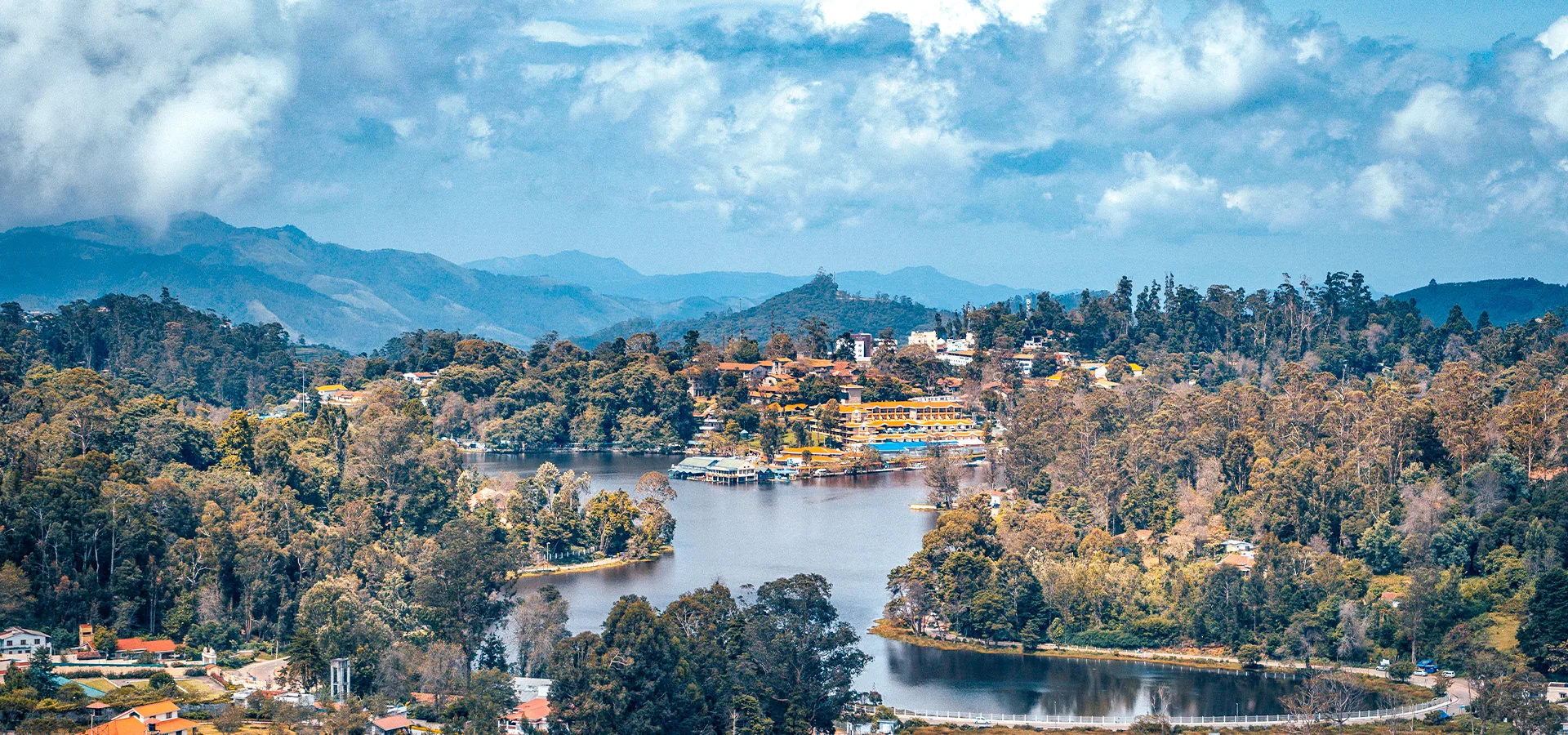
Morning in Ooty: the Botanical Garden (22 hectares, established 1848; 20-million-year-old fossilised tree) and Doddabetta Peak (2,637m — highest point in the Nilgiris, with views across Tamil Nadu and Karnataka). Drive to Kodaikanal (190 km, ~5 hours) through the Palani Hills. Arrive at India's 'Princess of Hill Stations' at 2,133 metres on a granite plateau. Evening walk around Kodaikanal Lake.
Full day in Kodaikanal. Coaker's Walk — a 1 km promenade cut into the cliff edge of the plateau with vertical drops of 2,000m to the plains (a telescope is stationed for panoramic viewing). Pillar Rocks — three vertical granite pillars rising 122m above the valley. Berijam Lake — 25 km through dense shola forest reserve (Forest Department permit arranged by us). Bear Shola Falls. Evening: the Kodaikanal Solar Observatory — one of Asia's oldest, with public access to the grounds at dusk.
Drive down from Kodaikanal to Madurai (120 km, about 3.5 hours) — the descent from 2,133m to the Tamil Nadu plains is spectacular, with the city of Madurai eventually appearing far below. Check in and visit the Meenakshi Amman Temple in the afternoon — one of the greatest temples in the world. This vast complex, dedicated to Goddess Meenakshi (a form of Parvati) and Lord Sundareswarar (Shiva), has been in continuous use since the 5th century BCE. Its 14 gopurams range in height from 45 to 52 metres and are encrusted with thousands of painted stucco sculptures. The 1,000-pillar Kilikoondu Mandapam and the sacred Porthamarai Kulam tank are extraordinary.
The night puja (closing ceremony) at the temple, at around 9:30 PM, when the deity is ceremonially carried to the inner sanctum, is one of the most atmosphere-laden rituals in South India — deeply worth attending.
Morning: the Thiruparankundram Murugan Temple — a rock-cut cave temple 8 km from Madurai, one of the six Arupadai Veedu (abodes of Murugan) in Tamil Nadu, and one of the oldest cave temples in South India. Drive east to Rameshwaram (165 km, 3.5 hrs) — the road ending at the extraordinary Pamban Bridge, a 2-km drawbridge over the Palk Strait to Pamban Island. Rameshwaram is one of the four dhams (sacred pilgrimage sites) of Hinduism, where the Ramanathaswamy Temple stands on the site where Lord Rama is said to have worshipped Shiva before the crossing to Lanka. The 22 theertham (sacred tank) corridor inside the temple — the world's longest temple corridor at 1.2 km — is an extraordinary procession of pilgrims and ceremonial bathing.
Morning: Dhanushkodi — the ghost town at the eastern tip of Pamban Island, accessible by 4WD along the beach, where the ruins of a 1964-cyclone-destroyed town and the meeting of the Bay of Bengal and the Indian Ocean make for an eerie and beautiful landscape. Drive south to Kanyakumari (270 km, about 5.5 hours) — the very tip of mainland India, where the Arabian Sea, Bay of Bengal, and Indian Ocean meet.
Arrive in the afternoon. Take the short boat ride to the Vivekananda Rock Memorial (where Swami Vivekananda meditated in 1892) and the towering Thiruvalluvar Statue (a 133-foot granite figure of the Tamil poet-saint). Visit the Kumari Amman Temple on the seafront. Watch the sunset from the famous tri-sea confluence point.
The sunrise at Kanyakumari is the reason to spend a night here: as the sun rises over the Bay of Bengal, it simultaneously illuminates the Arabian Sea to the west — one of the most genuinely moving natural experiences in India. After breakfast, continue to Trivandrum Airport (90 km, 2 hours) for your departure flight, or continue on to Kerala for further exploration. The tour concludes here at the tip of India.
Inclusions & Exclusions
Included ✓
- ✓ Accommodation in handpicked hotels throughout
- ✓ Daily breakfast throughout
- ✓ Private air-conditioned vehicle for all transfers
- ✓ English-speaking driver-guide throughout
- ✓ All applicable taxes
- ✓ Airport / station transfers
- ✓ Mysore Palace guided tour
- ✓ Belur & Halebid Hoysala temple guided tour
- ✓ Kodaikanal Berijam Lake forest permit
- ✓ Boat to Vivekananda Rock Memorial, Kanyakumari
Not Included ✗
- ✗ Flights / trains to / from destination
- ✗ Travel insurance (strongly recommended)
- ✗ Lunches & dinners (except where specified)
- ✗ Personal expenses & shopping
- ✗ Gratuities for guides & drivers
- ✗ Temple / monument entry fees (unless stated)
- ✗ Special darshan tickets at Ramanathaswamy Temple (purchased locally)
- ✗ Dhanushkodi 4WD vehicle (optional — payable locally)
- ✗ Ooty Botanical Garden and Nilgiri Mountain Railway (optional)
- ✗ All monument and temple entry fees
Your questions, answered
The Hoysala temples built between 1100–1300 CE in the Hassan district are among the most remarkable achievements in world architecture. Every surface — from the plinth to the tower — is covered in an unbroken carpet of stone carving: elephants, horses, stylised foliage, scenes from the Ramayana and Mahabharata, celestial dancers, and extraordinarily detailed figurative sculpture. The quality of the carving rivals anything produced in Egypt, Greece, or medieval Europe. Most Western travellers have never heard of them; those who visit are invariably stunned. We allow at least 2 hours at each site and always include a knowledgeable guide.
Rameshwaram town and the outer courts of the Ramanathaswamy Temple are open to all visitors. The inner sanctum is restricted to Hindus. The famous 1,200-metre corridor with its 22 sacred theerthams (water tanks) is the temple's most extraordinary feature and is accessible to all visitors who are appropriately dressed (modest clothing required; lungis are available for hire at the temple entrance). The boat to Vivekananda Rock is open to everyone. The island town itself is welcoming and safe.
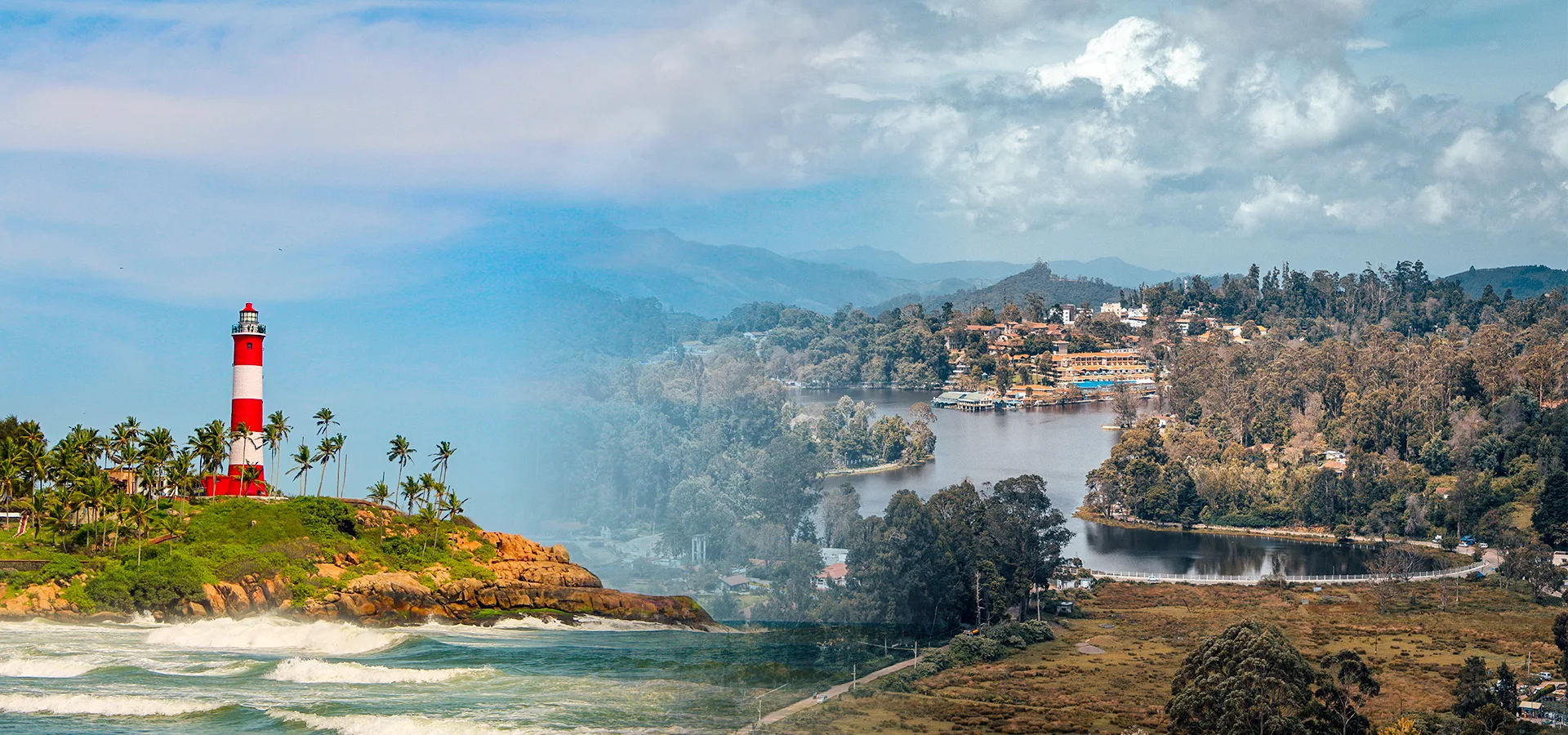
Absolutely — the tour ends in Kanyakumari, which is just 90 km from Kovalam Beach and 2 hours from Trivandrum. An extension into Kerala — adding 3–5 nights in Kovalam, Kumarakom, Munnar, or the Alleppey backwaters — is one of our most popular add-ons. Ask us to design a combined South India + Kerala itinerary for you.
Absolutely. Every Discover India tour is fully private and tailored to you. We can adjust duration, swap destinations, or add extensions. Submit an enquiry — no obligation.
We include carefully vetted 4-star and 5-star hotels throughout — heritage properties, boutique city hotels, and resort stays. Upgrades available on request.
Most nationalities can apply for an Indian e-Visa at indianvisaonline.gov.in. Takes 3–5 business days. Apply at least 2 weeks before travel.
October to March is ideal — cooler temperatures, clear skies, and the post-monsoon lush landscape. Most South India temples and hill stations are accessible year-round; the Nilgiris get monsoon rains June–September.
60+ days before departure: full refund minus admin fee. 30–59 days: 75% refund. 15–29 days: 50%. Under 15 days: no refund. Travel insurance strongly recommended.