Mandawa was founded in 1755 as a fortified trading town in the Shekhawati region — a part of Rajasthan whose merchant families, having grown wealthy on the old caravan trade routes, competed with one another by commissioning increasingly elaborate frescoes on the exterior walls of their havelis.
The result, across Mandawa and the wider Shekhawati region, has been called the world's largest open-air art gallery — hundreds of painted facades depicting religious scenes, royal processions, and (in a charmingly anachronistic touch from the early 20th century) trains, cars, and even early aeroplanes, painted by artists who had only heard such things described.
Tourism here is unhurried and intimate compared to Rajasthan's bigger cities — Mandawa Fort itself is now a heritage hotel, and a walk through the town's lanes, camera in hand, remains the simplest and most rewarding way to experience it.
Mandawa sits in the Shekhawati desert belt, with a climate similar to the rest of northern Rajasthan.
Cool and comfortable (10–25°C) — ideal for unhurried walking tours of the haveli lanes, which have little shade.
Post-monsoon, with temperatures beginning to ease and fewer visitors than peak winter season.
Very hot, regularly above 42°C — the exposed, narrow streets offer little relief from the sun.
Six landmarks — frescoed havelis and the fort itself — that define a visit to this open-air gallery town.
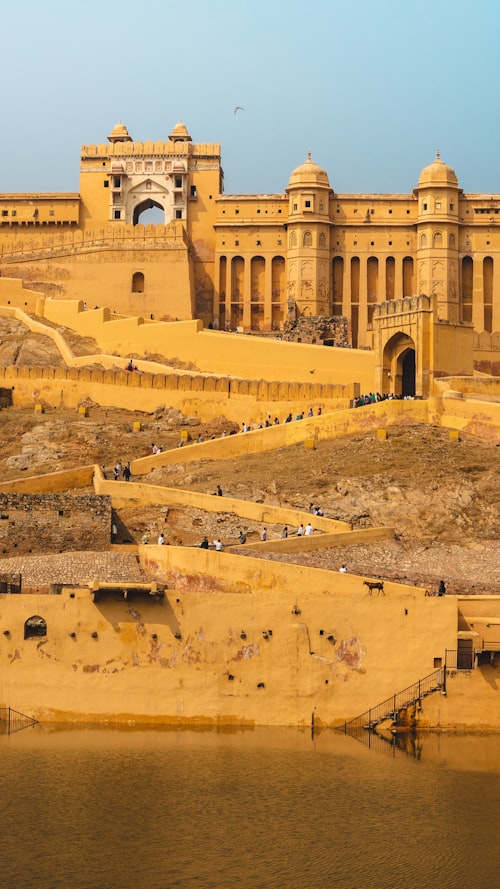
An 18th-century fort at the town's centre, now a heritage hotel — its courtyards and turrets remain open for non-guests to explore the architecture and views.
Two adjoining havelis with some of Mandawa's finest and best-preserved frescoes, including scenes of European-style figures and early motor cars painted by artists who had never seen either.
A richly decorated merchant mansion with erotic and mythological frescoes alongside more conventional religious imagery, typical of Shekhawati's eclectic painted tradition.
Among the most photographed facades in Mandawa, with vivid blue and ochre frescoes depicting deities, processions, and daily life from the era of its construction.
One of the original fortified entrances to old Mandawa, still standing at the edge of the haveli quarter — a useful orientation point for a walking tour.
A slow camel-cart ride through Mandawa's lanes and surrounding countryside — an easy, atmospheric way to see more havelis and rural Shekhawati life.
Mandawa's old town is compact enough to explore entirely on foot — most of its finest frescoed facades sit within a 20-minute walk of each other.
A local guide is genuinely useful here, as many of the most interesting painted details are easy to miss without context.
Now a heritage hotel, the fort remains the town's visual anchor — its rooftop and courtyards offer the best vantage points over Mandawa's painted skyline.
Even non-guests can usually arrange a visit to appreciate the architecture and views.
Mandawa is the most visited of several Shekhawati towns — Nawalgarh, Fatehpur, and Dundlod all hold their own remarkable haveli collections within a short drive.
A multi-town day trip rewards travellers with extra time, revealing the sheer scale of this regional fresco tradition.
Mandawa sits in the Shekhawati region north of Jaipur, typically visited as a day trip or overnight stop between Jaipur and Bikaner.
Jaipur International Airport (JAI), about 170 km away, is the nearest airport with significant connectivity.
Mandawa has a small railway station with limited connectivity; most travellers reach it by road from Jaipur or while travelling between Jaipur and Bikaner.
A comfortable private vehicle journey connects Mandawa to Jaipur, and onward to Bikaner — a popular stop on a northern Rajasthan circuit.
What to eat, and a few customs worth knowing, before you arrive
The Rajasthani staple, served at most Mandawa heritage hotels and guesthouses.
Hearty millet flatbread with a tangy yoghurt curry — a Shekhawati regional staple, simple and warming.
Shekhawati's merchant-town heritage shows in its rich, ghee-based sweets, often served at heritage hotel dinners.
The frescoes reward careful photography — a zoom lens helps capture detail on higher, weathered facades.
The haveli quarter is best explored on foot over uneven, sometimes dusty lanes.
Many havelis are still privately owned and occupied — view exteriors respectfully and ask before entering any that appear open.
A few practical things worth knowing before you arrive in Mandawa.
A guide who knows the families and history behind each haveli adds enormous depth to what can otherwise look like 'just paintings'.
Early morning and late afternoon light brings out the colour and texture of the frescoes far better than the flat light of midday.
A slow camel-cart tour through the lanes is a uniquely Mandawa way to see the havelis and surrounding countryside.
Several havelis and the fort itself have been converted into atmospheric heritage hotels — worth choosing over a generic option.
Nawalgarh and Fatehpur, both nearby, hold equally remarkable havelis — worth a half-day extension if time allows.
The haveli lanes offer little shade — carry water, particularly if visiting outside the coolest winter months.
Mandawa is a small, generally very safe town; as everywhere, agree guide fees clearly before a tour begins.